Understanding Workplace Hazards and Foot Protection
Identifying Common On-Site Risks
South Africa’s construction sector reports some of the highest workplace injury rates in the country, and a disproportionate share of those injuries strike the feet. A single falling brick or a misjudged step can cause serious damage, yet many workers treat these hazards as routine.
The ground itself hides the real danger. Scattered rebar, loose nails, and jagged rock create puncture hazards that ordinary footwear cannot resist. Add the constant threat of crushing from heavy materials or moving machinery, and the need for protection becomes undeniable. Common on-site risks include:
- Falling tools or building components
- Sharp debris embedded in mud or sand
- Cuts and lacerations from broken concrete
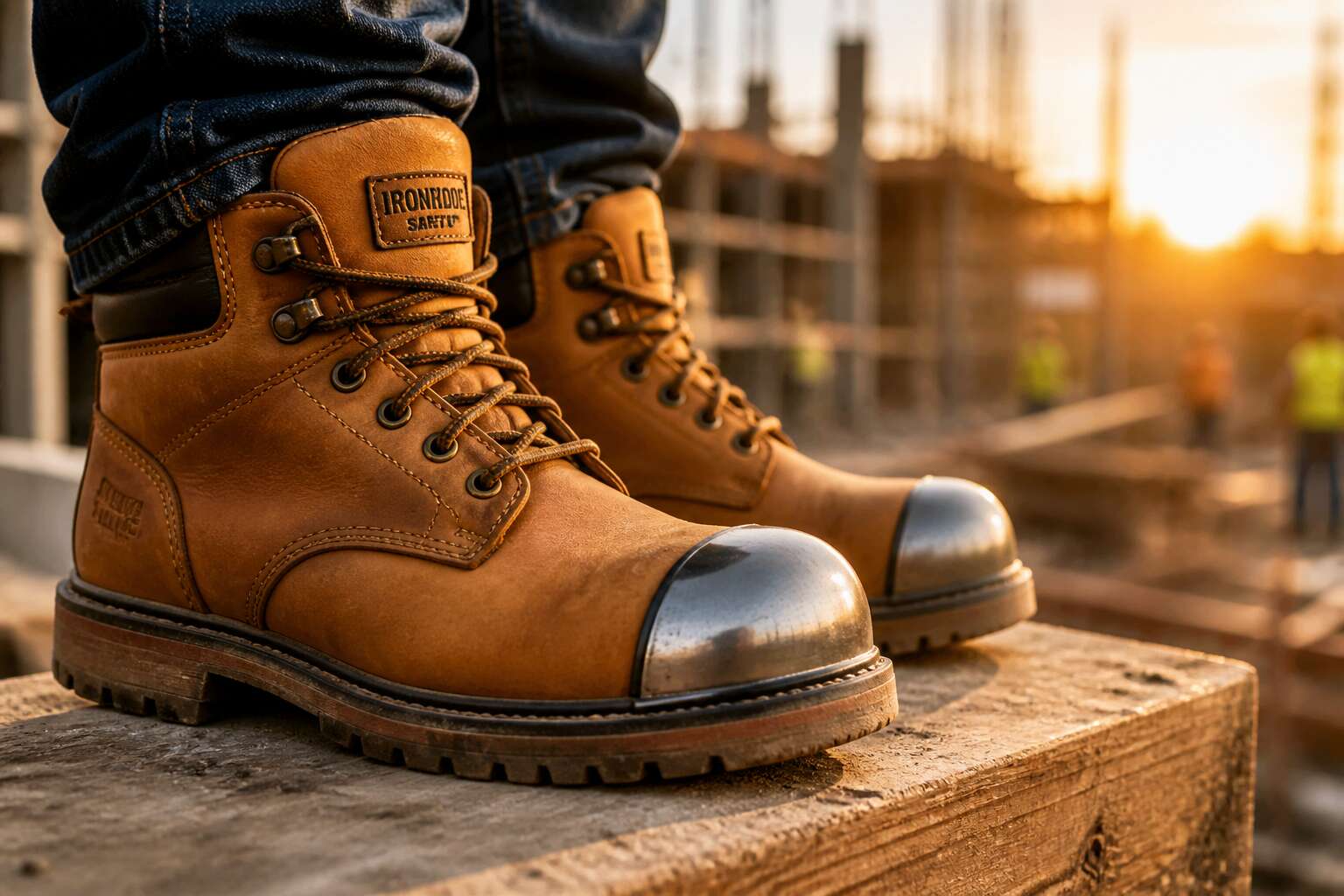
Each scenario demands more than a sturdy sole. Construction safety boots provide reinforced toe caps and puncture resistant midsoles that absorb impacts before they reach the foot. Choosing construction safety boots without checking the sole pattern is a risk no site manager should accept.
How Impact and Compression Injuries Occur
Every impact injury begins the same way. A falling object transfers kinetic energy into the foot faster than the tissue can absorb it. A dropped spanner, a swinging hook, or a dislodged brick delivers this sudden force, fracturing metatarsals or crushing toes in a split second. There is no time to step away!
Compression injuries occur through sustained pressure. A foot pinned between heavy surfaces suffers continuous load that crushes blood vessels and kills tissue. This happens when reversing vehicles trap a boot, when stacked loads collapse, or when machinery shifts during maintenance.
Common compression hazards:
- Vehicle wheels rolling onto an anchored foot
- Sliding steel beams pinning the instep
- Counterweights settling on the toe area
Construction safety boots must counter both mechanisms. Impact protection spreads the blow across the reinforced toe structure, and compression resistance keeps the boot intact under sustained weight. The right construction safety boots determine whether that force reaches the bones.
The Role of Footwear in Mitigating Falls and Slips
Rain turns dust to slick clay on a Highveld site. A thin film of grease hides steel like a trap. Falls happen between one breath and the next, and the foot is the first point of contact. Grip is the enemy of gravity. A good sole with deep lugs digs into the mire, while a worn one sends you skating toward a scaffold edge.
The sole is also a platform. Uneven terrain and rebar wait for an ankle. A stable boot holds the foot firm. Consider the ground:
- Wet steel decking after a thunderstorm
- FRP gratings dusted with fine sand
- Painted concrete that turns to ice in winter
Every surface has a story. Your construction safety boots must write a different ending. The outsole’s compound resists oil and heat, but its pattern does the work. A defined heel catches the ground before you lose balance. The risk is the misstep.
Puncture and Electrical Hazards on the Jobsite
A nail that missed the timber by five millimetres stands upright in a puddle, waiting. You will not see it. Your foot will find it. A puncture through the sole puts you in a clinic within hours. A composite or steel midsole in your construction safety boots is the difference between a bad day and a worse week.
Electrical hazards are quieter. A live cable under a metal deck, a frayed cord dragging through mud. The right construction safety boots carry an electrical hazard rating, meaning the sole resists current flow. Consider the situations where you depend on this:
- Standing on wet concrete while wiring a distribution board
- Kneeling near exposed copper while another crew runs a generator
- Walking through a puddle that hides a temporary power line
Your boots are the last piece of PPE between you and the ground, which is rarely on your side. Check the rating. Check the sole. Then take the next step.
Key Standards and Certifications for Protective Footwear
OSHA Requirements for Jobsite Footwear
I have watched workers trust a brand name more than a certification mark. That is a mistake. For construction safety boots, the standard printed inside the shaft is the only proof that the boot was tested.
In the United States, OSHA requirements for jobsite footwear reference ASTM F2413, the standard that governs impact resistance, compression, and metatarsal protection. South African contractors on multinational projects will see this standard cited regularly. The same logic appears in EN ISO 20345, the European benchmark, and in local SANS guidelines. All of them demand clear markings so a worker can verify what a boot can withstand.
The certification label typically tells you:
- The toe cap’s impact rating.
- The compression rating for rolling loads.
- Whether the sole resists electrical hazards.
Without these markings, you are wearing a heavy shoe, not construction safety boots. A standard number is the only honest claim a manufacturer can make.
ASTM F2413 Rating System Explained
The code stamped inside the shaft is a quiet confession. ASTM F2413 breaks a boot into measurable truths, each letter and number a witness to what the boot endured. For construction safety boots, this rating system is the difference between assumption and certainty.
- I/75 marks impact resistance against a 75 pound force.
- C/75 marks compression resistance under a rolling load.
- Mt/75 signals metatarsal protection with the same threshold.
EH confirms the sole can handle electrical hazards. These markers do not embellish. They state only what a machine verified. When the label lacks these codes, the boot is unproven. Trust the numbers, not the name.
European EN ISO 20345 Safety Classes
Europe’s EN ISO 20345 uses a different alphabet, but the question is the same: can a pair of construction safety boots take a beating? The S classification sorts them, and the letters that follow reveal the real details.
S1 covers the basics: toe protection and closed heels. S1P adds midsole puncture protection. S2 makes the upper water resistant. S3 brings puncture protection and a cleated sole for rough terrain.
- S1: toe protection, closed heel
- S1P: S1 plus puncture resistant midsole
- S2: water resistant upper
- S3: S2 plus puncture protection and cleated sole
South African sites widely accept these classes alongside ASTM F2413, though the tests differ. The label is the only truth worth trusting.
Understanding Toe Impact and Compression Ratings
Steel beams do not care about your brand loyalty. They care about the toe impact and compression ratings printed on your construction safety boots. Impact testing drops a weighted striker onto the toe cap at speed. Compression testing applies a static load, slowly and mercilessly, until the cap yields. Each rating corresponds to the force the cap resists before flexing.
In South Africa, both ASTM and EN ISO standards use these tests, though the thresholds differ. The label on the tongue is the only evidence worth trusting. A scrape or abrasion on that label is a reason to replace the boots. The tests are unglamorous, but they separate a good day from a very bad one.
Electrical Hazard and Conductive Footwear Standards
Electrical hazards are invisible, which makes them more dangerous than any falling beam. A worker’s body can become a conduit for current when it meets a live circuit, and the right sole can break that path. For most sites, Electrical Hazard (EH) rated footwear is the standard, tested to withstand 18,000 volts at 60 Hz for one minute without leakage. The certification means the outsole and heel are designed to resist current flow, offering a critical barrier in dry conditions.
Conductive footwear serves the opposite purpose. It drains static electricity from the wearer into the ground, preventing sparks in explosive atmospheres. These boots are essential for powder coating, munitions handling, and grain silo work where a single static discharge can ignite a disaster.
When choosing between them, consider the environment:
– EH rated boots for general construction, electrical work, and utility tasks
– Conductive boots for volatile, dust-laden, or explosive environments
– Never use conductive boots near live electrical circuits
Reading the label on construction safety boots is the only way to confirm which standard applies. The ASTM F2413 mark with an “EH” designation or the EN ISO 20345 symbol with a specific code tells you exactly what protection the boot offers. A boot that lacks these markings is just footwear, not a safety device.
Slip Resistance and Sole Markings
Slips, trips and falls account for nearly a quarter of workplace injuries in South Africa. Yet most workers never examine the sole pattern, let alone the markings molded into the rubber. I see it on every site. Those markings tell the real story!
Slip resistance is measured under controlled conditions. The EN ISO 20345 standard splits testing into two scenarios: SRA for ceramic tile with soap solution, SRB for steel with glycerin. A boot that passes both earns the SRC mark. That single code on the sole tells you the boot handles wet and oily surfaces. For construction safety boots, sole markings also indicate slip resistance ratings:
- SRC: passes both slip tests
- SRA: passes tile test only
- SRB: passes steel test only
The ASTM equivalent, F2913, uses a whole shoe test on a contaminated surface. A higher coefficient of friction means less slip. When you buy construction safety boots, the marking is the proof that matters.
Essential Features to Look for in Durable Work Boots
Toe Cap Materials: Steel vs. Composite vs. Alloy
One misstep on a rain soaked scaffold taught me that toe caps earn their keep differently. Steel is the old workhorse, delivering raw impact strength, but it turns your foot into a heat sink and a live current conduit. Composite caps discard that conductivity and shave off weight, yet they often add bulk to the boot’s profile. Alloy then emerges as the middle path, matching steel’s protection with a lighter frame, though it still conducts thermal and electrical energy.
The right material depends on your specific rigours:
- Steel: durable and tough, but heavy and conductive.
- Composite: non conductive and lightweight, but thicker for equivalent ratings.
- Alloy: lighter than steel with similar impact resistance, yet still conductive.
These trade-offs carry real consequences, because construction safety boots must endure the entire shift, not merely clear a certification test.
Sole Technology for Grip and Support
A boot’s support starts with the shank, the rigid insert that bridges the heel and toe. Steel shanks deliver uncompromising torsional rigidity for ladder rungs and rebar, while composite shanks offer equivalent support without the weight penalty. Your working surface determines the right choice.
Outsole design carries its own demands:
- Deep, directional lugs that self-clean in mud
- A defined heel edge for ladder rungs
- A polyurethane midsole for impact absorption
Construction safety boots with a slight rocker profile keep your gait natural when carrying loads, reducing the strain that builds by mid-afternoon.
Waterproofing and Breathability
A foot sweats roughly half a pint during a standard shift. Seal that moisture inside a boot and you create the conditions for blisters, fungal infections, and the kind of chronic discomfort that sends skilled workers home early. Waterproofing and breathability are not opposing demands. Both are solved by the same layered membrane technology.
The best construction safety boots balance these priorities through careful material selection. A waterproof breathable membrane, often polyurethane or ePTFE, blocks external water while allowing vapour to escape. The upper material matters equally. Full-grain leather resists water naturally but restricts airflow. Split leather breathes easier but requires more frequent waterproofing treatment.
- Look for a boot with a sealed tongue and gusseted construction.
- Check that the membrane extends to the collar as well as the toe.
- Consider moisture-wicking insoles for the highveld’s temperature swings.
Electrical Insulation and Heat Resistance
The highveld’s temperature swings test the limits of your footwear’s materials as much as your own endurance. Electrical insulation in construction safety boots does not mean full protection against all current. It means the boot resists a specific voltage under controlled conditions, stopping current from reaching your feet when you step on a live source. That protection degrades with moisture, contamination, and ordinary wear.
Heat resistance operates differently. The outsole and midsole compounds must keep their shape when you work near hot asphalt, welding sparks, or sun-baked steel decking. A rubber compound with a high heat deformation point holds its structure and grip. Both properties matter equally on a site where buried cables and fresh tar sit metres apart.
- Check the maximum operating temperature of the sole compound
- Confirm the electrical insulation rating matches site voltage exposure
- Inspect for cuts or cracks that compromise both protections
Comfort Innovations: Shock Absorption and Arch Support
Shock absorption begins the moment your heel strikes the ground. On the highveld’s hard, compacted earth, that impact travels straight up your legs unless the midsole intervenes. I’ve tested boots that feel great in the shop but punish you by lunchtime. Modern soles use air pockets, PU foam, or specially formulated EVA to compress and rebound with every stride. The sole should absorb the force, not your knees.
Arch support works alongside shock absorption to keep your foot stable inside the boot. A flat or collapsing arch changes your gait, shifts pressure points, and leads to early fatigue. The insole, heel cup, and midsole work as a system.
These elements function together in construction safety boots:
- A removable insole that accommodates custom orthotics
- A midsole with at least 20% rebound rate
- A heel cup that keeps your foot locked in place
Selecting the Right Pair for Different Construction Roles
General Labor vs. Heavy Machinery Operation
Ask any site foreman and they will tell you: no two boots serve the same worker equally. A general labourer covering fifteen kilometres a day across rough terrain needs construction safety boots that favour flexibility and low weight. An operator perched on a vibrating platform needs construction safety boots built for entirely different demands.
Heavy machinery work punishes the heel and the Achilles tendon. Vibration dampening, a rigid heel counter and fuel resistant outsoles matter more than stylish toe caps. The operator needs stability when climbing wet tracks and feedback when pressing pedals.
- General labour prioritises nimbleness, breathability and all-day wear
- Machine operation prioritises shock absorption, ankle locking and oil resistance
Choosing the wrong pair for either role creates discomfort that compounds over a shift. The right pairing barely gets noticed. That silence is the whole point.
Working on Roofs and Elevated Surfaces
Elevated work changes the rules of footing. A blistered rubber membrane on a commercial roof demands a different traction than a pitched clay tile, so the sole must conform to each surface without losing grip. Mass becomes an enemy; a heavy boot yanks the leg forward when you step down, testing the Achilles tendon on every landing. Construction safety boots built for height pair a dense shock absorbing midsole with a slim toe profile that catches narrow purlins.
Most roofers I know check three things before they trust a boot on a gable edge:
- how the boot slides onto a ladder rung
- whether the toe curls enough to hook a lip
- if the shank flexes exactly under the ball
The heel counter locks the foot in place, dampening the small rotations that accumulate into fatigue. These details decide whether the boot works for you or against you, one beam at a time.
Electrical and Utility Work Applications
Electrical and utility crews face a different kind of decision. The boot must resist moisture that conducts current, yet remain flexible for long walks across uneven terrain. I have seen linemen choose construction safety boots with a defined heel for climbing ladders and poles, while ground crew favour a flat outsole that sheds mud without caking.
Material matters here. Leather uppers repel water, but stitching creates a path for dampness. Many utility workers prefer a vulcanised rubber bottom fused directly to the upper. This reduces seams and keeps the foot dry in wet grass or shallow trenches.
- Reinforced shank for climbing rungs and pole steps
- Non-metallic hardware to reduce conductivity risk
- Compression-resistant toe for heavy cable reels
Fit takes priority over fashion. A loose boot slips on wet concrete, while a tight one restricts blood flow in cold conditions. The right construction safety boots balance these demands without compromise.
Managing Mud, Water, and Chemicals
Across a single site, the ground shifts from clay to crushed stone to curing concrete. Construction safety boots must follow the task. A rebar crew needs a puncture-resistant midsole that flexes underfoot, while a demolition crew relies on a steel toe cap against falling debris. The role determines the sole, the guard, and the grip.
- Scaffolders benefit from a square toe and stiff shank for narrow planks
- Groundworkers require a self-cleaning tread and waterproof membrane
- Finishers prefer lighter boots with cushioned heels for long hours on hard slabs
Managing mud, water, and chemicals starts with the boot’s construction. Wet clay cakes into treads and turns a sure step into a slip. A tread with open lugs releases mud instead of packing it. Cement slurry and chemical spills degrade cheap leather quickly, so a full-grain upper with a vulcanised rubber lower resists daily exposure. Construction safety boots for this climate need sealed seams and chemical-resistant outsoles to hold up season after season.
Matching Boots to Seasonal Weather Conditions
Selecting the right pair starts with honest assessment of the daily workload. A welder on a bridge project faces different demands than a site supervisor walking kilometres of earthworks. Construction safety boots should match the worker’s actual environment. Heavier boots protect, but they drain stamina by midday. In my experience, a boot that fits poorly causes more lost time than any twisted ankle.
Seasonal conditions complicate the choice. South African sites swing from scorching summer heat to icy winter mornings. Construction safety boots that trap heat become unbearable at 35 degrees. Breathable linings help, but so does the outsole. Winter frost creates slick steel decks. A sole that stays pliable in cold weather outperforms hard thermoplastics that stiffen overnight.
The South African climate demands three seasonal profiles:
- Summer: lightweight shafts, vented collars, heat resistant outsoles
- Winter: insulated uppers, cold weather rubber compounds
- Transition months: medium insulation that handles daily temperature swings
Caring for Your Protective Footwear to Extend Lifespan
Daily Cleaning and Maintenance Routines
Construction safety boots endure more abuse in a week than most office chairs see in a decade. Daily cleaning prevents that abuse from becoming permanent damage. Each evening, brushing off dried mud and dust protects the leather from abrasive particles that grind into the surface.
Wiping the uppers with a damp cloth and drying them in the shade prevents heat damage, since accelerated cracking invites moisture. Checking sole treads for embedded stones or wire is equally important, as a sharp object can compromise the boot’s protective structure. South African sites are unforgiving on soles, especially after summer downpours.
Weekly conditioning maintains the water-resistant barrier that keeps chemicals and moisture away from your feet. Leather that turns brittle loses flexibility, which reduces grip and comfort. Consistent care costs minutes a day, while replacing damaged construction safety boots costs money and time.
Inspecting for Wear and Hidden Damage
That nightly brush-off does more than keep your construction safety boots presentable, it opens the door for a ritual. Discovering wear and hidden damage is where you catch trouble before it catches your toes.
Delamination separates the sole from the upper, ending in a flapping hazard. Look at the toe cap area, where scuffs can expose composite or steel. Pinch the sides. Soft spots in the rand mean the glue is letting go. Give the shank a twist test; it should resist your grip, not bend into a U shape.
- Inspect the heel for uneven wear that tilts your ankle.
- Check the tongue for tears that let in dust.
- Press the padding to confirm it still springs back.
That inspection is your safeguard for any pair of construction safety boots. Once the structure goes, repair costs climb past replacement costs, so retire a pair the moment the sole separates.
When to Replace Worn-Out Boots
Construction safety boots endure far more than the eye can measure. The leather may gleam after a brush, yet the internal structure carries every impact. Caring for your protective footwear involves conditioning the leather, drying the lining thoroughly, and allowing the boots to rest between shifts. Rotating two pairs can extend the service life significantly, because moisture evaporates fully and fibres regain their form.
However, even the most diligent care cannot prevent eventual wear. When the outsole loses its tread depth beyond 3 millimetres, or when the midsole compresses to the point of losing shock absorption, the boots become liabilities. Replace worn-out boots when the cost of repair approaches half the price of a new pair. Periodic maintenance postpones that moment, but the moment remains.
A boot used for a year of groundwork has fulfilled its purpose. Retire it before failure occurs.
Proper Storage and Drying Methods
Highveld humidity can age a pair of construction safety boots faster than any workload. Dampness crawls into the lining, softens the leather, and rusts the hardware from within. I have seen boots fail after one wet season, simply because they were dried wrong. Dry boots slowly, away from direct sun and heater grates. Rapid heat shrinks the hide and cracks the sole.
Storage matters just as much. Keep boots upright in a dry, ventilated space. A cedar shoe tree pulls moisture from the toe box overnight. Never seal boots in plastic; the trapped condensation undoes every drying effort. Let the boots rest a full day between shifts so the midsole rebounds and the fibres regain their shape.
Resoling and Reconditioning Considerations
Resoling is a decision that demands honest assessment. The upper may still cradle the foot with integrity, but a worn tread on a wet steel beam is a gamble no worker should take. For construction safety boots with cemented soles, a resole often costs more than a new pair. However, Goodyear welted and stitch-down constructions respond well to a skilled cobbler’s hands.
Reconditioning leather extends life more practically than any machine. Clean away the grime, then feed the hide with a conditioner that contains beeswax or lanolin. This restores oils that washing strips away. Consider these points before paying for repairs:
- Check whether the replacement sole still meets the original ASTM rating for impact and compression.
- Confirm the cobbler uses original or equivalent materials for the outsole and midsole.
- Measure heel wear and midsole compression; a crushed midsole cannot be reconditioned.
A reconditioned boot that fails mid shift is worse than no boot at all. Know when good care becomes false economy, particularly on uneven highveld terrain where the margin for error is slim.

0 Comments