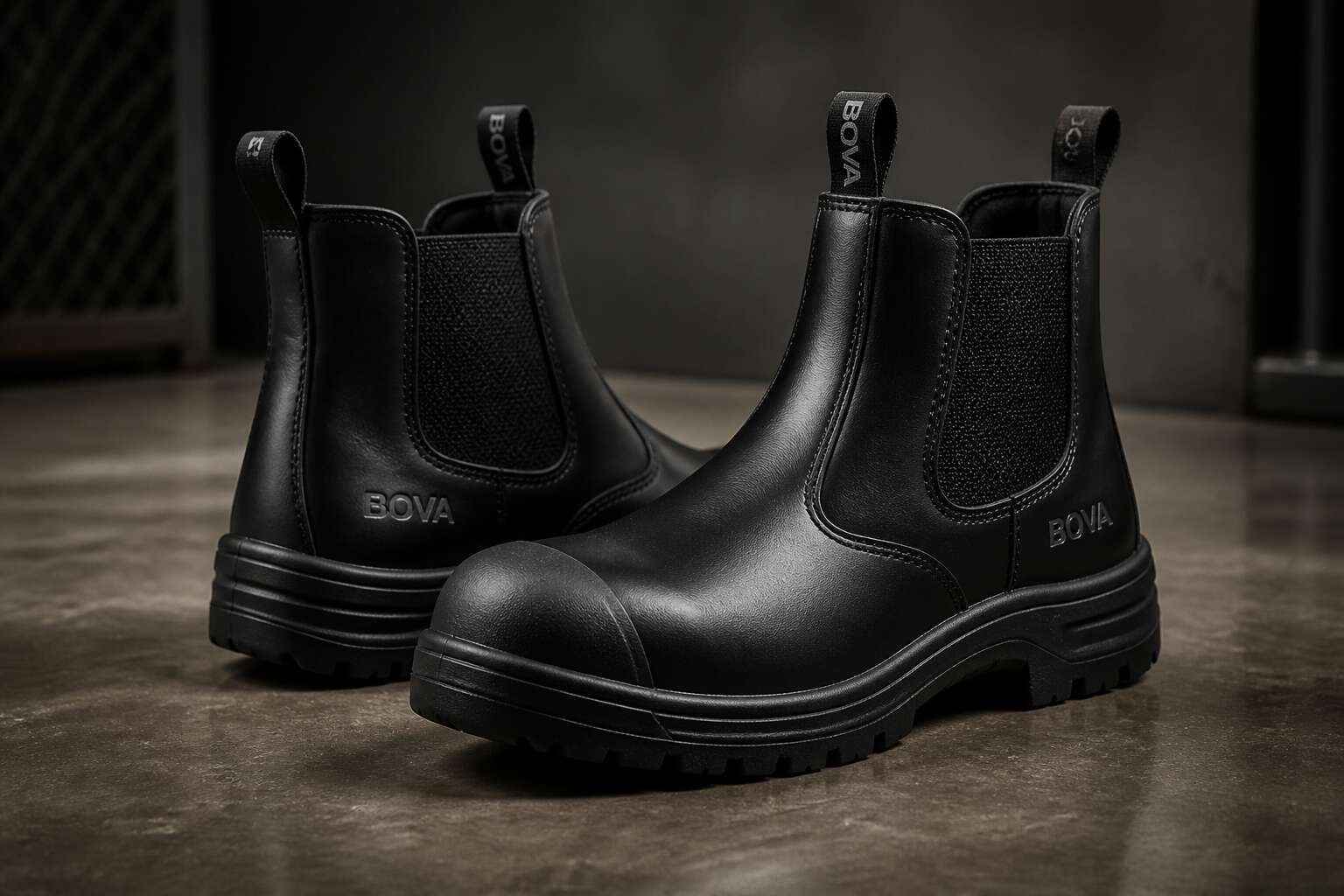
Bova Chelsea Boot Range: Comfort Meets Compliance
A Brief Overview of Bova Footwear
Most safety boots feel like punishment by the end of a shift. The Bova Chelsea Boot Range proves otherwise. These chelsea safety boots bova are engineered for long hours on concrete floors. The dual density sole absorbs impact while the steel toe cap handles the unexpected. Double elastic panels allow quick removal at the gate. SABS approved, they meet the compliance standards required across South African industries.
What sets the range apart is the fit. The padded collar grips the ankle without pinching. The insole supports the arch for workers who never sit down. I have watched teams pick these chelsea safety boots bova over heavier options. They move well, they breathe, and they hold up! For anyone who wants compliance without the daily grind, this range delivers consistently.
The Appeal of the Chelsea Boot Silhouette in Safety Wear
The average South African worker spends over 1,800 hours on their feet each year. That is a long time to wear footwear that fights back. The chelsea safety boots bova range treats the Chelsea silhouette as a functional advantage. No laces means no lunch break wasted on retying. The elastic gusset stretches to hug the instep, but entry stays quick.
Why the Chelsea shape suits safety wear:
- Slip-on speed gets you through the gate faster.
- Clean lines leave fewer crevices for dust and grime.
- The low profile clears machine guards more easily.
The chelsea safety boots bova line shows that compliance does not require a bulky, stiff boot. The padded collar and arch support handle comfort, while the SABS rating handles the paperwork. You get a boot that works a full shift and still looks presentable at the pub. That is the real appeal of the silhouette.
Who Should Consider Bova Chelsea Boots
Nobody wakes up hoping to spend the day in a boot that feels like a punishment. The Bova Chelsea range understands that comfort and compliance are not opposing forces. The chelsea safety boots bova blend a memory foam footbed with a steel toe cap that does not announce itself with every step. That matters in Durban’s humidity or Joburg’s dusty yards. The boot breathes, the sole grips wet concrete, and the SABS mark keeps the inspector silent.
Who should consider the chelsea safety boots bova? The electrician who climbs ladders forty times a shift. The warehouse picker who walks ten kilometres before lunch. The technician who steps from a bakkie into a boardroom, because a Chelsea boot does not demand changing shoes. These workers benefit from a boot built for daily use:
- A slip resistant outsole for oily floors
- A padded ankle that supports without squeezing
- A removable insole that accommodates orthotics
This is comfort with a certificate, and it fits the rhythm of a South African working day.
Comparing Bova with Other Safety Boot Brands
Most safety boots pass the SABS hammer test long before they fail the 4 p.m. foot test. The chelsea safety boots bova occupy a different category. Competing brands treat steel toe caps as the only requirement, leaving a rigid chassis that punishes the metatarsal. Bova pairs its compliant steel toe with a shock absorbing midsole and a TPU outsole that grips oil soaked concrete.
Other manufacturers rely on generic lasts. Bova shapes the boot around the South African foot, wider through the forefoot, more accommodating at the instep. A padded ankle collar reduces heel slip, a common complaint with imported tactical boots. The removable insole handles a 12 hour shift without going flat. I have worn cheaper boots that demanded weeks of suffering.
The comparison points are:
- Price to durability ratio beats most imports
- Minimal break in period
- SABS certification without a stiff, board like feel
The chelsea safety boots bova feel less like equipment and more like footwear, which is the point.
Technical Features That Set Bova Chelsea Boots Apart
Durable Leather Uppers and Water Resistance
The leather on Bova Chelsea boots is not merely decorative. It undergoes a treatment that repels water while still allowing the hide to breathe. This matters in South African conditions where a sudden downpour can leave you soaked by lunchtime. I have seen lesser boots crack after a few wet seasons, but Bova’s uppers hold their integrity. That is a genuine difference!
Consider what this means for daily wear:
- The full-grain construction resists scuffs and abrasions.
- A sealed welt prevents moisture from seeping into the footbed.
- The elastic gusset stays flexible yet snug, even when damp.
Each element works together. The result is a boot that keeps your feet dry without turning them into saunas. For anyone relying on chelsea safety boots bova, this combination delivers reliable comfort shift after shift!
Steel Toe vs. Composite Toe Options
Choosing between steel toe and composite toe in chelsea safety boots bova is not a trivial decision. It changes how the boot performs on your actual shift. Steel toe caps are forged for maximum impact resistance. They handle dropped beams and crushing forces without flinching. But they conduct heat and cold, which can become punishing during long outdoor hours in the Highveld sun.
Composite toes solve a different problem. They weigh less, which reduces fatigue over a twelve hour shift. They also stay neutral in temperature and will not trigger security scanners. Consider these differences when you evaluate your work environment:
- Steel toe suits heavy industry, mining, and construction sites.
- Composite toe fits logistics, electrical work, and roles requiring frequent movement.
Both options maintain the Chelsea profile, so you never sacrifice style for safety. The real question is what your feet face daily.
Anti-Slip and Oil-Resistant Outsoles
A puddle of hydraulic fluid does not announce itself. It sits there, glossy, waiting. The outsole of chelsea safety boots bova has been engineered with this exact hazard in mind. Anti-slip performance is not a checkbox. It is a measurable outcome of rubber chemistry and tread geometry working together.
Bova uses a nitrile rubber compound that resists oil absorption. When oil cannot penetrate the material, surface contact remains consistent. The tread lugs are spaced to shed contaminants rather than trap them, which matters on wet steel and polished concrete.
The technical elements:
- Compounds tested for heat resistance and oil degradation
- Channel patterns that disperse water from the contact patch
- Sole profiles designed for standing on inclined surfaces
These outsoles follow South African slip resistance protocols, evaluated under dry and lubricated conditions, so your footing holds up across a full shift.
Shock Absorption and Cushioning Systems
Standing on concrete for ten hours causes measurable compression in the lumbar spine. Your body needs a layer that absorbs that force. The chelsea safety boots bova use a dual density polyurethane midsole that deforms under impact, then recovers. This reduces shock traveling into the knees and lower back.
The footbed supports the arch and spreads pressure evenly, preventing the burning sensation in the ball of the foot. A heel pad softens the first contact of every step.
Here is what the cushioning system includes:
– Return foam with high rebound properties
– A shock absorbing layer under the heel bone
– An insole that maintains thickness after weeks of use
These features change how your body handles a full shift. Choosing chelsea safety boots bova means your spine gets the support it needs.
Breathability and Moisture-Wicking Linings
Your feet release roughly half a cup of perspiration during a ten hour shift. When a boot traps that moisture, the skin softens, friction rises, and blisters form quickly. The chelsea safety boots bova counter this with a lining system built to move sweat outward rather than hold it against the flesh.
The design uses multiple zones for moisture management:
- A mesh layer against the skin that wicks fluid instantly
- An antimicrobial coating that prevents bacterial breakdown of sweat
- A breathable heel counter that allows air exchange with every step
This matters in South Africa’s varied climates. Whether you work in Durban’s humidity or Johannesburg’s dry air, the boot regulates internal temperature naturally. A drier foot means less friction, fewer heat points, and a boot that lasts longer because the lining does not degrade from constant dampness.
Safety Standards and Industry Certifications
Understanding EN ISO 20345:2011 Rating
In workplaces across South Africa, the difference between a safe day and a disabling injury often comes down to footwear compliance. The International Labour Organization reports over 340 million occupational accidents occur globally each year, and foot protection remains a primary defence against many of these incidents. When evaluating the chelsea safety boots bova range, the certification behind the leather and stitching determines genuine protection levels.
The EN ISO 20345:2011 rating is the benchmark for modern safety footwear. This European standard classifies boots using a specific system of letters and numbers, each denoting a level of protection against impact, compression, and penetration. A basic rating of SB ensures the toe cap withstands 200 joules of energy. Higher ratings like S1, S2, and S3 add criteria for antistatic properties, energy absorption in the heel, water resistance, and even specific outsole requirements.
For the chelsea safety boots bova, the S3 rating indicates the highest tier within this classification. It means the boot offers:
– 200 joule impact resistance in the toe cap
– Antistatic and energy absorbing properties
– Water resistance in the upper material
– Penetration resistance from the outsole
This certification is not a marketing tactic; it is a legal and practical necessity for industries such as mining, construction, and logistics. I always check the stamp inside the boot before recommending it to friends working on the Highveld. The standard provides peace of mind that the boots have been independently tested and verified for the demands of daily labour.
S1P vs. S3 Protection Levels
Choosing between S1P and S3 requires reading the work environment, not just the label. S1P certification covers antistatic properties, heel energy absorption, and a steel or composite midsole that blocks penetration. S3 incorporates all of those safeguards, then elevates the specification with a water-resistant upper and a rugged, slip-resistant outsole.
- S1P: the economical choice for dry, controlled indoor settings such as warehouses and assembly lines.
- S3: the resilient option for wet, abrasive outdoor sites where mud, water, and loose stone punish lesser boots.
The chelsea safety boots bova appear in both classes, but the S3 variant carries the full certification. For workers crossing the Highveld’s hard ground or navigating wet processing plants, the S3 stamp settles the question. It signals that the chelsea safety boots bova have been tested for the harshest conditions South African industry can produce.
Electrical Hazard and Heat Resistance Properties
Electrical hazard protection sounds less glamorous when you realise it means your boots refuse to turn you into a human fuse. The chelsea safety boots bova undergo dielectric testing to meet the relevant EN ISO standards, ensuring they can handle accidental contact with live circuits without conducting. Heat resistance is a separate ordeal entirely. The outsole and upper materials face controlled challenges involving contact heat and molten metal splash, all verified through laboratory procedures rather than marketing enthusiasm.
– The outsole resists contact heat up to a defined temperature threshold.
– The upper withstands molten metal splash without igniting or degrading.
These dual properties matter for electricians and welders who treat their feet as a safety boundary, not a fashion statement. The chelsea safety boots bova carry this certification without forcing you to wear a cape. Unless you want to. That part is optional.
Styling the Bova Chelsea Safety Boot
Pairing with Jeans and Trousers for Work
Pairing your chelsea safety boots bova with the correct trouser changes how the whole outfit reads on site and in the office. Straight leg jeans sit cleanly over the elastic gusset, keeping the silhouette tidy without bunching. Tapered cargo trousers work well too, because the ankle cuff stays close to the boot and doesn’t catch on the pull tab. For smarter workplaces, a tailored chino with a slight break at the hem offers a polished line.
I lean toward darker denim for a more professional finish. Lighter washes feel casual, which suits warehouse roles but not client meetings. The practical detail is the hem length. A short break shows the boot’s profile, while a long stack of fabric hides it and can trip you on stairs.
The safety ratings are already built into chelsea safety boots bova, so the styling simply needs to respect the boot’s shape. Wide leg cuts and flared trousers disrupt that clean line. A neat fold at the ankle solves the problem without altering the boot’s function.
Transitioning from Site to Street
The commute from a Johannesburg site to a Melville bar takes thirty minutes, but the mental shift takes longer. The chelsea safety boots bova are designed to cross that gap without requiring a shoe change. I keep them on. The leather sole and reinforced toe have done their job all day, so there’s no reason to treat them like a liability once the sun goes down.
A pair of slim-cut chinos and a plain cotton shirt replace the hi-vis. The boot’s elastic gusset sits flat under the trouser cuff, so nothing snags on the threshold of the car door. On the street, the silhouette reads as intentional, not lazy. It looks like a choice. That’s the real value of a boot that works for both contexts.
The same grip that held on wet rebar holds on polished concrete. The cushioning that absorbed the hammering of a concrete floor now absorbs the unevenness of a pavement. The chelsea safety boots bova don’t need to be dressed up or down, they just need to be worn. No laces to retie, no straps to adjust, just a clean line from the site gate to the bar stool.
Seasonal Styling Tips
The Highveld summer storm does not check your calendar. The chelsea safety boots bova shrug off the sudden downpour when you are caught between a client meeting in Sandton and a dinner in Parkhurst. I wear them with cropped linen trousers that clear the ankle. The elastic gusset stays visible, which actually works in your favour.
Winter mornings on the Highveld are cold and dry. You want heavier socks and a boot that sits cleanly under the trouser hem. A pair of wool chinos tucked over the shaft keeps the wind out without looking contrived.
For autumn, consider:
- Dark denim rolled once at the cuff
- A waxed jacket over a merino knit
- The boot’s oiled leather taking on a deeper patina as temperatures drop
These boots handle the transition from the site truck to the restaurant terrace without demanding a shoe swap. They read as deliberate footwear for every season, not a compromise.
Accessorizing and Fit Considerations
Fit starts at the heel. A boot that shifts on the rear of your foot will destroy your gait. For the chelsea safety boots bova, the composite toecap provides ample toebox volume, but that only works if your heel stays planted. Sizing down to eliminate slippage can crush your metatarsals.
- Check the instep tension. The elastic gusset should not leave deep marks.
- Try a thin orthotic insole to correct flat arches before altering the boot size.
- Allow a thumb’s width between your longest toe and the cap.
Accessorizing matters less than this initial geometry. A correctly fitted shaft and a snug gusset seal out gravel and dust. The leather will stretch slightly over time, so a firm fit at the ankle today means a reliable fit next month.
Maximizing the Lifespan of Your Bova Boots
Cleaning and Conditioning Leather
Most safety boots fail from neglect, not impact. The leather dries out, cracks, and loses integrity long before a steel toe ever bends. Your chelsea safety boots bova demand a simple ritual. Spend fifteen minutes a week and they will repay you with years of service.
Start with a soft brush to lift embedded dirt. Then use a damp cloth, not a soaking one. Apply a quality leather conditioner with your fingers, working it into the seams and heel. Let it absorb overnight. For the South African climate, especially the Highveld’s dry winters, condition every six to eight weeks.
- Remove salt and chemical residue after every site shift.
- Store boots away from direct sunlight and heat sources.
- Use cedar shoe trees to preserve the toe shape.
In my experience, neglect is the only real enemy. A pair of chelsea safety boots bova that is cleaned and fed will outlast three pairs that are not.
Proper Storage and Rotation
Storage shapes a boot’s lifespan more than most owners realize. A leather upper can be fed and polished, but a pair of chelsea safety boots bova left overnight against a generator or wedged under a seat buckles quietly. Heat softens the sole adhesives. Coastal humidity migrates into the lining and lingers for days.
Rotation changes that equation. Alternate two pairs and each boot gets a full day to release moisture and reclaim its shape. A midsole that carries your weight for an entire shift needs that recovery time. A rested boot holds its arch support longer and keeps its ankle grip firm.
In my experience, site workers who stretch one pair of chelsea safety boots bova across two years of heavy concrete work often find the leather intact while the underfoot foam collapses. Compression damage is cumulative. A cool storage spot out of direct sunlight and a steady rotation between pairs prevent that failure.
When to Replace Your Safety Boots
The average South African site worker replaces a pair of chelsea safety boots bova every nine to fourteen months, but I have seen boots fail in six. That failure usually starts underfoot.
Maximizing the lifespan of your Bova boots starts with understanding what actually wears out. The leather upper can last years, but the midsole and outsole carry the real burden. Once the heel angles inward or the tread loses its bite on wet concrete, your stance is already compromised.
When to replace your safety boots is a question of function, not aesthetics.
- A smooth patch on the outsole where the tread once gripped.
- A steel or composite toe that presses through the upper after impact.
- An ankle that folds sideways when standing flat.
If any appear, the boot is done. Replacing your chelsea safety boots bova at the right moment is cheaper than a physio bill.
Buying Guide and Pricing
Where to Purchase Genuine Bova Chelsea Boots
A counterfeit pair of safety boots can fail in the first week. That is the real cost of chasing a bargain. Buying genuine chelsea safety boots bova starts with knowing your retailer, especially in South Africa where fake stock moves through informal markets and social media.
Authentic pairs with an S1P or S3 rating land between R1,400 and R2,200. If the price sits far below that range, alarm bells should ring. Inspect the boot before you pay.
- Check the Bova logo placement and stitching quality
- Confirm the seller is an authorised distributor
- Request the EN ISO 20345:2011 certificate or serial number
Purchase from dedicated safety footwear shops or the official Bova channel. Your feet carry your weight every shift, so source boots from a supplier who actually answers for the product.
Price Range and Value for Money
Shopping for chelsea safety boots bova requires patience and a suspicious eye. A genuine pair with an S1P or S3 rating costs between R1,400 and R2,200. That price range reflects the certification, the leather, and the outsole compound. Drop below it and you are buying a boot that fails within a week.
The money buys a boot that holds its shape after months of concrete work. The stitching stays tight, the toe cap stays put, and the sole keeps its grip on oily surfaces. That is where the value lies.
- Confirm the EN ISO 20345:2011 marking on the shaft
- Check the Bova logo placement and serial number
- Buy from an authorised distributor, not a market stall
Paying R1,800 upfront beats paying R600 twice and losing a toenail.
Sizing and Fit Recommendations
One boot that fits badly can cost you three shifts. When you choose chelsea safety boots bova, the fit deserves as much attention as the certification. These boots run narrow through the instep, and your usual street size will often feel tight after two hours of walking. Measure your feet in the late afternoon, when they have expanded from the day’s heat. Wear the same work socks you use on site, not thin dress socks.
A half size up is common for people who stand on concrete or climb ladders. The heel should grip without slipping, and your toes should brush the front cap only when you flex forward. Break them in gradually. Start with two hours indoors, then four, then a full shift. The leather will soften around the ankle and across the midfoot without losing its shape.
Pricing for genuine chelsea safety boots bova stays steady between R1,400 and R2,200. Authorised distributors sometimes include a free pair of insoles or a lace exchange, but they never discount below that range. A cheap boot is never a bargain.
Warranty and After-Sales Support
Most buyers focus on the upfront cost, yet the real value of chelsea safety boots bova shows up in the warranty. A genuine pair carries a manufacturing defect guarantee that covers sole separation and stitching failure within the first six months. Authorised retailers handle the claim directly, so you do not chase the manufacturer.
Before purchasing, confirm the seller is on Bova’s approved list. Unauthorised imports often miss the local warranty coverage. Keep your invoice and the original box. Without proof of purchase, the claim process stalls. After-sales support differs by store, but responsible dealers offer honest advice on fit and maintenance.
When weighing a deal, check these points:
– Warranty period stated in writing
– Whether the retailer or Bova handles returns
– Turnaround time for replacement boots
– Availability of after-sales repairs or parts
A solid after-sales setup matters as much as the boot itself, especially when you rely on them daily.

0 Comments