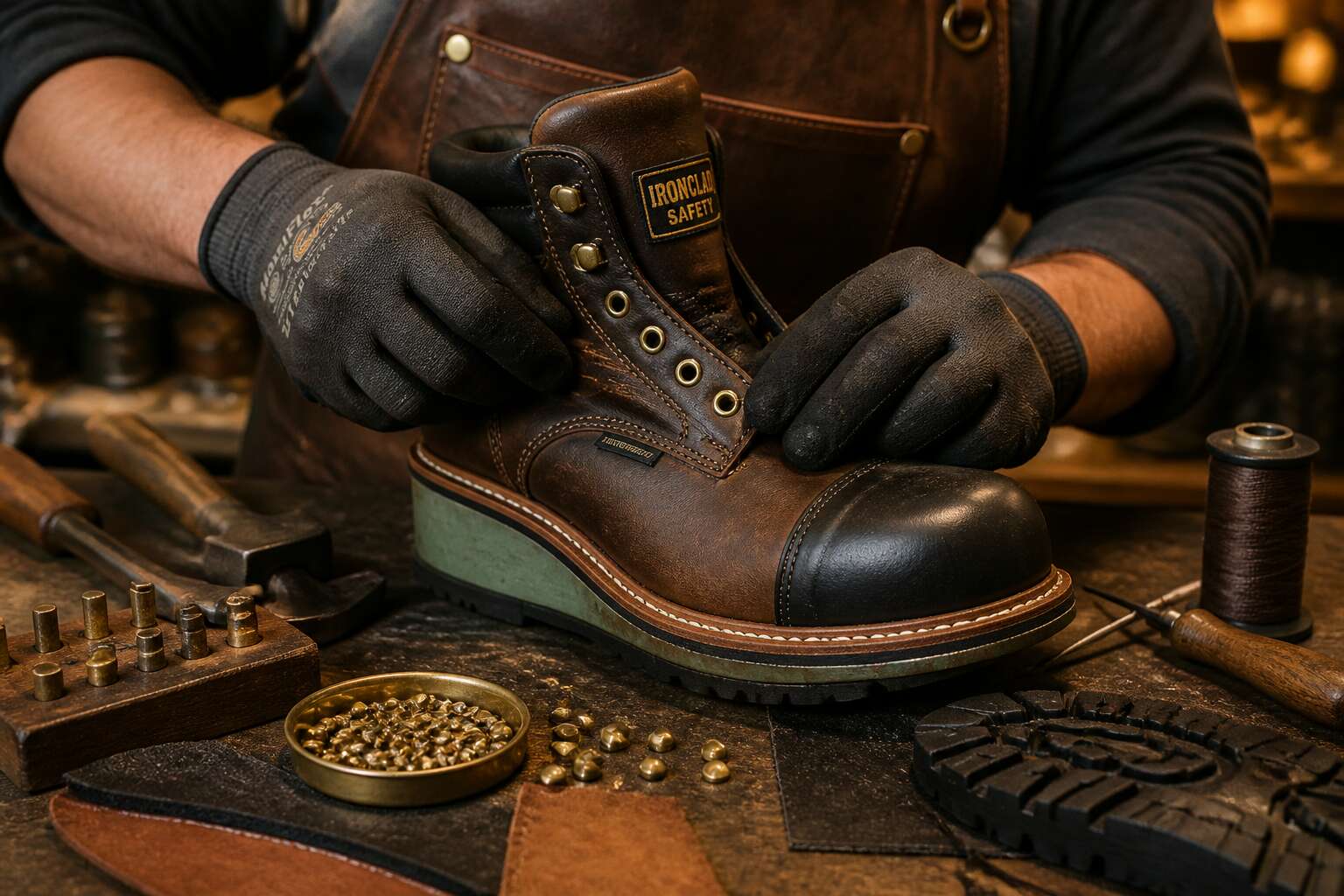
Materials That Define Durability
Leather Grades and Selection
Across the Karoo, I have watched safety boot builders inspect a hide with sharp focus. They know full grain leather, with its unbroken surface, repels water and abrasion best. Top grain, sanded for smoothness, balances comfort and resilience. Split leather, cheaper and softer, fails too soon under sharp rubble.
- Full grain retains the natural fiber structure.
- Top grain has a corrected surface.
- Split leather comes from the lower layers.
For safety boot builders, selection starts with the animal’s origin. Central Asian hides often show tighter grain, while South American cattle produce looser texture. A builder who skips this inspection constructs a boot that collapses within months, not years!
Composite vs. Steel Toe Caps
A boot’s toe cap rarely gets a second thought until a falling beam tests it. Safety boot builders know the choice between composite and steel changes how a boot performs on a hot mine dump or a freezing night shift.
Steel toe caps offer maximum impact resistance. They are heavy and conduct cold, which makes winter work miserable. Composite toe caps are lighter and non-conductive, so they do not chill the foot or set off security scanners.
- Steel handles repeated heavy knocks, but it can deform under extreme force.
- Composite absorbs impact differently and may crack after severe abuse.
I have seen safety boot builders weigh these trade-offs before every build. A welder needs non-conductive protection. A scrap handler needs steel.
Slip-Resistant Outsole Compounds
The outsole absorbs the first impact. Safety boot builders study rubber compounds with exacting attention. Nitrile rubber handles oil, heat, and the abrasive crush of mine rock. Polyurethane offers cushioning but breaks down in extreme heat. Thermoplastic polyurethane bends without cracking at freezing temperatures.
I have watched outsoles fail on Johannesburg sites when the compound was too soft for summer tar. A proper slip-resistant outsole needs a balance of grip, durability, and abrasion resistance. The tread pattern matters, but the polymer matrix underneath matters more.
- Nitrile: resists oil and sparks
- TPU: flexible in cold
- Rubber: best for wet surfaces
Builders select compounds based on the work site, not the catalogue.
Breathable and Waterproof Membranes
Your feet exude half a litre of moisture per shift. Trap that inside a boot and you invite maceration, blisters, fungal infections. Safety boot builders in South Africa wrestle with a peculiar contradiction. The Highveld demands ventilation under the summer sun, while the Cape winter turns sites into mud baths. A successful membrane must reject external water while expelling internal vapour.
Microporous films achieve this through pores measuring one hundredth of a water droplet’s diameter. Moisture vapour passes through. Liquid water cannot. These membranes are laminated between the leather and the lining. The configuration matters:
– A full bootie wraps the entire foot, offering complete waterproofing.
– A partial bootie covers only the toe and heel, reducing cost but leaving gaps.
The moisture vapour transmission rate determines the outcome. Anything below 4000 grams per square metre per 24 hours traps sweat. Rates above 8000 keep a working foot dry even in Mpumalanga heat.
Insulation and Thermal Linings
Your feet shed heat at a rate that would shame a radiator, yet most safety boot builders treat insulation as an afterthought. On a Free State winter morning, the ground chills through a thin lining in minutes. Thermal linings combat this through materials like Thinsulate, which traps air without adding bulk, or shearling for extreme cold. But insulation is a double edged sword. Trap too much heat and you trade frostbite for trench foot.
- Closed cell foam reflects radiant cold while remaining flexible.
- Aluminised mylar bounces body heat back to the foot.
- Merino wool wicks moisture while insulating even when damp.
The trick is matching your climate. Highveld summers demand minimal insulation, while underground mines need Arctic grade protection. A safety boot builder that ignores this balance produces footwear that either freezes or sweats.
The Step-by-Step Construction Process
Pattern Making and Cutting
Pattern making is the quiet first act in a boot’s life. For safety boot builders, this stage turns measurements into templates, anticipating how leather will stretch and settle. A pattern that misses by two millimetres can ruin the fit of the entire boot. Cutting then transforms those templates into real parts. The cutter must respect grain direction, avoiding weak spots that could split under strain.
- Draft the pattern on sturdy card.
- Lay out each piece on the hide.
- Press the cutting die with steady force.
- Inspect every cut edge for flaws.
These steps demand patience. In a workshop outside Johannesburg, I watched a seasoned builder reject three hides before finding one suitable for cutting. That vigilance is why the final boot holds up. Pattern and cutting decide everything that follows.
Precision Stitching Techniques
The cutting room’s last whisper fades into the thrum of the stitching floor. Safety boot builders know that a needle’s rhythm is merciless. One errant perforation can unravel the entire vamp! Here, the upper comes alive, piece by piece.
The machine operator guides the leather with a steady hand. They adjust tension by feel, not by gauge. The thread must lock tight against the hide. A loose stitch invites moisture. A tight stitch tears the leather. This balance defines the craft.
- Closing the upper panels with a 3 mm seam allowance.
- Setting the heel counter with a double row of lock stitches.
- Bonding the toe box lining before lasting.
Each step binds the boot to its purpose. Durability is won or lost in the stitching.
Lasting and Molding
In the stifling quiet of the lasting room, the world narrows to the pull of a lever and the hiss of steam. This is where the builder’s will is pressed into the very fiber of the hide. The upper, stitched and whole, is dragged over the last like a skin over a skeleton. Moisture softens the leather, making it compliant, almost sentient. The operator’s hands move with a practiced gravity, stretching the vamp over the toe’s curvature until the grain smooths into a taut, unbroken plane. There is no room for hesitation here; a misstep now leaves a permanent crease that whispers of failure in every step to come.
The molding process is a test of patience against the clock. Heat is applied, and the leather is forced to remember a shape it never owned. It is a brutal, necessary ritual that separates a mere shoe from a tool of protection. For safety boot builders, this phase is the physical manifestation of accountability. The heel seat is wrapped, the waist is cinched, and the toe box is locked into place. A build that survives this operation with clean lines will likely survive the relentless pounding of a mining shift. It is the final argument in a debate about durability, won before the outsole ever meets the ground. The process of shaping dictates how the boot will eventually break in, how it will hug the foot, and how long it will hold its integrity.
To achieve this permanence, the process follows a brutal logic:
1. The insole is nailed to the last to secure the foundational plane.
2. The upper is pulled over the last with a manual lasting pincer, ensuring tension is even.
3. The lasting board is forced into the heel and toe to seat the upper firmly against the last.
4. The excess leather is trimmed and tacked, leaving a clean margin for the outsole.
5. The boot is then transferred to a hot curing station to set the molecular structure of the hide.
The final act is a punishment of heat and pressure. The leather is baked until it surrenders, then left to cool in a room that smells of dust and tannin. When the last is finally removed, with a sharp crack that echoes off the concrete walls, the boot stands alone. It is no longer a collection of parts. It is a monument to the hands that built it. The whisper of the needle and the groan of the press are gone, replaced by the silent promise of the finished shape. The safety boot builders know that this is the moment of birth, where flexibility is sacrificed for support, and all the earlier layers of protection find their final, unbending form.
Sole Attachment Methods
One out of every three industrial foot injuries involves a failure at the sole interface. For safety boot builders, the attachment of the outsole is where the upper’s crafted integrity meets the ground, and it is a process that tolerates no shortcuts. Once the lasting operation has set the shape, the builder must decide how to marry the upper to the outsole. This decision dictates the boot’s resilience against heat, chemicals, and the abrasive grit of a mine floor.
The most demanding method is direct vulcanisation. This process involves placing the lasted upper into a mold and injecting raw rubber under high pressure and temperature. The rubber flows into the texture of the upper and the lasting board, creating a chemical bond that is practically inseparable. For safety boot builders, this method produces a boot that offers superior resistance to delamination, a critical factor when workers are knee deep in mud or standing on surfaces slick with oil. The equipment required is significant, which is why this method is reserved for heavy industrial lines.
The alternative is cement construction. Here, the outsole is pre-formed and then adhesively bonded to the upper using a series of specific agents.
– The roughening of the outsole and upper contact points to expose a fresh surface.
– The application of a primer to both prepared surfaces to promote adhesion.
– The activation of the adhesive with heat or a chemical agent.
– The pressing of the outsole to the upper under a pneumatic press for a set duration.
This process is labor intensive and relies heavily on the precision of the builder. If the adhesive is applied unevenly, the boot will fail at the worst possible moment. The choice between these methods is a conversation about environment. Vulcanised boots handle heat and friction, while cemented boots offer flexibility and a lighter weight for long shifts. The final step often involves a heat setting station to cure the bond, removing any residual moisture and ensuring the weld between leather and rubber is permanent. The builder inspects the line where the sole meets the upper, checking for gaps or uneven separation. This is the last line of defense before the boot is boxed. A boot that survives this scrutiny is a testament to the builder’s understanding of materials under stress, a quiet assurance that the wearer’s footing is secure when they step onto a steel beam or a wet concrete slab. It is a silent pact made in the factory, honored on the job site.
Heel and Shank Installation
Some workers think a safety boot’s heel is merely a place to hook a ladder rung. In reality, the heel and shank assembly is the structural skeleton that stops your foot from becoming a human accordion. Without a properly fitted steel or composite shank, the arch collapses and the boot twists like a wet newspaper. Safety boot builders know that this component is the difference between a long career and a long physio waiting list.
The shank installation is a delicate operation. It involves placing a rigid insert between the insole and the outsole to resist flexing. Most builders use either forged steel or a high-density polymer, with the polymer gaining favour for its lighter weight and cold resistance. The critical part is ensuring the shank sits flush against the lasting board. Any gap will produce a pressure point that feels like a pebble in your shoe, except the pebble costs R800 and a trip to the chiropractor.
Heel attachment follows a specific sequence to ensure the boot stands square. The builder must:
1. Rough the base of the heel block to create a mechanical key.
2. Apply a contact cement to both the heel and the boot base.
3. Align the heel under a pneumatic press to seat it evenly.
4. Drive stainless steel nails in a radial pattern through the heel into the shank.
This last step is where the builder’s patience is tested. A misaligned nail will split the heel stack and compromise the boot’s stability on uneven terrain. The heel itself is typically a layered stack of leather or compressed rubber. Leather heels are traditional and offer a firm grip on ladder rungs, but rubber heels provide better shock absorption for concrete floors. Safety boot builders often combine both: a rubber base for impact and a leather top for that satisfying click as you walk through the warehouse. The final heel height is a compromise between ankle support and manoeuvrability. Too high, and you risk rolling an ankle on gravel. Too low, and the Achilles tendon takes a beating on long shifts. The builder checks the heel alignment with a simple straight edge, ensuring the boot stands plumb on the bench. It is quiet, unglamorous work, but it is the reason a worker can sprint across a mine yard without feeling like they are running on jelly.
Final Assembly and Trimming
One uneven cut can doom an entire boot. I have watched safety boot builders pull the last from a finished upper, and this step exposes any hidden flaw in the leather. The edges receive their final trim, demanding a steady hand and a razor blade. Safety boot builders follow a specific sequence:
- Trim the lining flush with the upper.
- Bevel the outsole edge to prevent premature wear.
- Buff the heel and waist for a uniform surface.
- Apply edge dressing and let it cure.
A crooked cut cannot be fixed. It exposes the underlying fibres and weakens the boot’s seal. After trimming, the builder checks the toe cap alignment and flex point. The boot must bend exactly where the foot bends, no earlier. This final stage takes two minutes, but it decides whether the boot lasts a year on a construction site. No pressure!
Meeting Safety Standards and Certifications
Understanding Impact and Compression Ratings
The SABS 1556 and EN ISO 20345 certifications are the baseline for safety boot builders in South Africa. Passing them requires precision. Impact ratings measure what happens when a 200 joule weight slams onto the toe cap. Compression ratings simulate a 15 kilonewton squeeze, roughly the weight of a small car resting on your foot.
A boot that survives the impact test might still fail compression if the toe cap distorts. That is why safety boot builders test for both forces. The rated values are legal thresholds, not optional guidelines.
Consider what each rating demands:
- Impact: the toe cap absorbs force without shattering.
- Compression: the toe cap resists deformation under sustained weight.
- Combined: the boot must pass both without cracking or sharp edges.
Electrical Hazard Protection
A single spark can turn a routine shift into a tragedy. Electrical hazard protection demands more than a rubber sole. Safety boot builders must engineer every layer to resist current flow while preserving comfort and flexibility. The SABS 1556 and EN ISO 20345 certifications outline specific procedures for electrical resistance. These tests simulate real working conditions, not dry laboratory perfection.
- Current leakage limits are measured under high voltage.
- Insulation integrity is checked after repeated flexing.
- Resistance is retested after exposure to moisture.
A boot that passes on day one can fail after a single damp shift. Certification requires lab verification of each material batch. For safety boot builders, this means sourcing compounds that remain non-conductive under strain. The standards are strict, and the margin for error is razor-thin.
Puncture Resistance Requirements
Puncture resistance is the quiet guardian of a site floor, a true test of a safety boot builders’ material cunning. While impact ratings often dominate the conversation, the humble nail or shard of glass waits for an unguarded moment. The SABS 1556 and EN ISO 20345 standards treat this threat with the gravity it deserves, demanding a protective midsole that can laugh in the face of a 1100 Newton force.
Manufacturers must choose between a flexible textile weave or a rigid steel plate. The challenge lies in the balance. A plate that is too stiff causes fatigue, while a textile that is too thin offers a false sense of security. Here is what the certification process actually checks:
1. The penetration probe applies force at a steady, measurable rate.
2. The clearance under the insole must remain under 4.5 mm after the test.
3. The entire sole construction must resist the probe without cracking.
A boot that fails this test is not just non-compliant, it is a liability on legs. The best safety boot builders integrate this protection directly into the lasting process, ensuring the barrier follows the natural contour of the foot. Catching a stray screw on a rooftop in Johannesburg is a daily occurrence, and the engineering must hold up to that reality. Penetration resistance is not about glamour; it is simply the difference between a minor inconvenience and a trip to the emergency room.
Chemical and Heat Resistance
One splash of molten zinc can send a worker to the burns unit. That is why chemical and heat resistance sits at the heart of safety boot builders’ certifications. EN ISO 20345 and SABS 1556 put the upper and outsole through tests that mimic the dirtiest corners of a South African factory floor. Oils, acids, alkalis, even a 300°C hot plate. The materials must survive without melting, cracking, or swelling!
The test sequence is plain:
- Heat contact checks the sole’s deformation point.
- Chemical swabs sit on the upper for a set period.
- Flexing machines bend the boot until fatigue appears.
Safety boot builders in Johannesburg know the paperwork means nothing if the rubber hardens in winter or the leather burns on contact. Certification sets the minimum. The actual test happens at 14:00 on a Tuesday in a foundry.
Certification Testing Labs
A 300°C hot plate tells you more about a work boot than any brochure ever will. But the plate alone does not issue a certificate. Certification testing labs exist to make those claims measurable and repeatable.
An accredited facility in Johannesburg takes a fully assembled boot and runs it through the EN ISO 20345 battery. The results are recorded, witnessed, and filed. Those files form the basis for the SABS mark on the heel. Reputable safety boot builders treat that mark as the start of accountability. A certification report carries three distinguishing features:
- The batch number and production date
- The specific EN ISO clauses tested
- The SANAS accreditation scope and certificate number
The lab is controlled. The foundry floor is not. That is why serious safety boot builders pull samples from every production batch, not only the pairs submitted for approval. A certificate earned in February loses its meaning if the rubber compound changes in July.
Custom Fit and Specialized Solutions
Custom Lasts for Unique Foot Shapes
Most people assume their feet are identical. They are not. One foot might be longer, the other wider. For workers who spend ten hours a day on concrete, this mismatch becomes a painful problem. Safety boot builders solve it with custom lasts, which are carved models of your exact foot shape. These lasts account for bunions, hammer toes, and other unique quirks. Consider what a custom last can address:
- Toe box volume for splay
- Instep height for high arches
- Heel width for stability
- Ankle circumference for support
Using a custom last means the boot follows your bone structure exactly. I have seen workers switch from off the shelf sizes to a fitted pair and report zero blisters by end of shift. That kind of precision takes time, but your feet will thank you. It is the hallmark of respected safety boot builders.
Wide and Narrow Size Options
The distance between a comfortable boot and a punishing one is often a matter of millimetres. Safety boot builders who offer wide and narrow size options understand that the human foot rarely conforms to a single standard. A narrow heel with a wide forefoot used to force a choice between a loose boot that slipped at the ankle or a tight one that crushed the toes.
Proper width grading eliminates that compromise. Workers with high-volume feet find room for thick socks without pinching. Slender feet get a secure grip, reducing friction blisters and foot movement. I have watched fitters measure both feet and then pull a wide-fitting boot from stock that required zero break-in. That immediate fit matters for workers who walk miles of concrete daily! Some manufacturers pair extra-wide toe boxes with narrower heel cups, a configuration suited to the varied foot structures common in South African industries.
Orthotic-Compatible Designs
The quiet war fought inside a work boot often happens beneath the arch. Orthotic compatible designs treat foot fatigue as a solvable engineering problem, not an inevitability. Safety boot builders who accommodate custom insoles understand that pain in the knee or lower back frequently originates at the ground contact point.
A removable insole is the first requirement. This allows workers to install prescribed supports without altering the boot’s external structure. Some manufacturers deepen the heel cup to hold orthotics in place, preventing the insert from sliding forward on descents. Others provide a wider metatarsal panel to prevent the foot from being compressed when a custom device adds volume.
Consider the specific features workers request most often:
– Removable polyurethane footbeds that retain their shape
– A heel cradle designed to stabilise the calcaneus bone
– A TPU shank that keeps the midfoot rigid while distributing weight
The integration of these elements requires precise engineering from the last upwards. In the South African climate, where heat swells the feet by midday, a boot that accommodates orthotics without becoming restrictive is a rare commodity. Workers who stand on hard concrete for ten hours demand this consideration. The best safety boot builders deliver it with every pair.
Task-Specific Boot Configurations
Every worksite demands a distinct answer. A welder balancing on steel beams needs lateral stability that a warehouse operator never considers. A miner crawling through low tunnels requires a reinforced toe rand that groundworkers would find unnecessary. The best safety boot builders treat task-specific configuration as the final layer of engineering.
The task itself shapes the boot. For electricians, a non-metallic shank prevents conductivity. For agricultural workers, a taller shaft changes the entire build. For demolition crews, a reinforced heel counter stabilises ladder descents. These are structural responses to real conditions.
Specific configurations we produce regularly:
- Extended ankle pivots for painters working on scaffolding
- Reinforced instep guards for forestry chainsaw operations
- Heat-resistant Kevlar stitching for foundry environments
Every element, from the last to the lacing system, bends toward the singular task at hand. Safety boot builders who adapt this way earn their keep on the factory floor.
Sustainability and Innovation in Footwear Production
Recycled Materials in Boot Manufacturing
Beneath the fluorescent hum of Cape Town’s factories, old plastics find new purpose. Today’s safety boot builders transform discarded fishing nets and bottle caps into durable uppers. Recycled polyester fibres, once bound for landfill, now weave into linings that endure the salt wind of the harbour. This innovation serves a structural purpose; melt-spinning technology produces yarns with tensile strength rivaling virgin materials.
- Reclaimed rubber from decommissioned conveyor belts, ground into new outsoles.
- Recycled PET, sourced from South African coastal waste, spun into breathable mesh.
- Post-industrial nylon scrap, used for abrasion-resistant heel counters.
Even the soles rise from this reclaimed stock. A boot compounded from recycled rubber offers dependable traction on wet steel. For the wearer, this means protection without compromise. For safety boot builders, sustainable sourcing is no longer a slogan but a tangible reality, a closed loop that benefits both the worker and the environment. This is progress, real and measurable!
Water-Based Adhesives and Solvents
The footwear industry has long relied on volatile solvents to bond materials. The smell of a new pair of boots often told the story of toxic cements. That era is fading for South African manufacturers. Water based adhesives now offer a viable path forward, reducing airborne pollutants in the factory without sacrificing the integrity of the final product.
Switching to water based systems demands a rethink of the production line. Solvent cements evaporate quickly, but water based formulations require precise temperature and humidity controls. Safety boot builders install drying tunnels and calibrated rollers to manage the moisture gradient. The payoff is a healthier workspace. When workers stop inhaling benzene and toluene fumes, their long term wellbeing improves.
This shift also changes how factories handle waste. Solvent residue required costly disposal methods. Water based adhesive remnants are easier to manage within wastewater treatment protocols. The operational benefits compound over time.
– Lower insurance premiums due to reduced fire hazards.
– Fewer respiratory complaints among assembly staff.
– Cleaner quality control checks without solvent interference.
– Compliance with stricter municipal environmental bylaws.
Safety boot builders in Cape Town have documented a measurable drop in headaches and dizziness among floor workers after the transition. The boots themselves perform to standard, passing abrasion and peel tests. The quiet revolution is happening in the mixing rooms and application booths. It is a practical upgrade, not a marketing slogan. Good boots and clean air are not mutually exclusive.
Reducing Carbon Footprint
South African manufacturers are discovering that reducing their carbon footprint is not a marketing exercise. It is an economic necessity. Electricity prices climb yearly, so factories that trim energy appetite protect their margins. Solar arrays on factory roofs now power cutting tables and conveyor belts. LED lighting replaces buzzing fluorescent tubes that waste power.
Some producers are rethinking logistics entirely.
– Local leather sourcing cuts freight distances.
– Recycled rubber compounds reduce raw material extraction.
– Optimised cutting patterns lower waste offcuts.
All of this innovation funnels into one outcome. A boot that costs less to make and produces fewer emissions. Safety boot builders who embrace these measures are securing their own future in a resource constrained economy.
Smart Footwear with Embedded Sensors
Safety boot builders in South Africa now embed sensors directly into boot soles during the moulding process. These sensors measure gait, pressure distribution, and surface temperature in real time. Mining operations use the data to spot fatigue patterns before injuries occur. Factory floors use the same telemetry to refine workstation ergonomics. This technology is practical, not decorative. It reduces downtime and compensation claims.
The same momentum drives material science. Researchers are testing bio-based polymers made from sugarcane and maize husks. These compounds match the durability of petroleum-based plastics while degrading faster at end of life. Closed-loop water systems that recycle tannery runoff cut chemical waste and municipal water dependence. Safety boot builders are also exploring natural rubber alternatives from local guayule shrubs, which thrive in arid regions.
Developments in focus:
- Sensor modules that survive repeated impact testing
- Solar powered charging docks for boot batteries
- Data platforms that integrate with existing safety management systems
The Future of Modular Boot Design
The era of disposable footwear is ending for South African industries. Safety boot builders are now approaching durability with a circular mindset, where the boot becomes a system of serviceable parts. This shift changes how companies manage their protective equipment budgets.
Modular construction is gaining ground. Instead of discarding an entire boot for a worn heel or damaged upper, workers can replace specific components. This approach extends the lifespan of the footwear significantly and reduces waste.
– Interchangeable outsoles with deep tread patterns for different terrains
– Replaceable inner liners that manage moisture and fatigue
– Quick release fasteners for laces, straps, and buckles
This model supports a more efficient, cost effective approach for safety officers. It also provides a clear advantage for safety boot builders managing stock and maintenance. The future lies in designing for longevity, not just initial protection. This reduces long term risk and liability for employers.

0 Comments