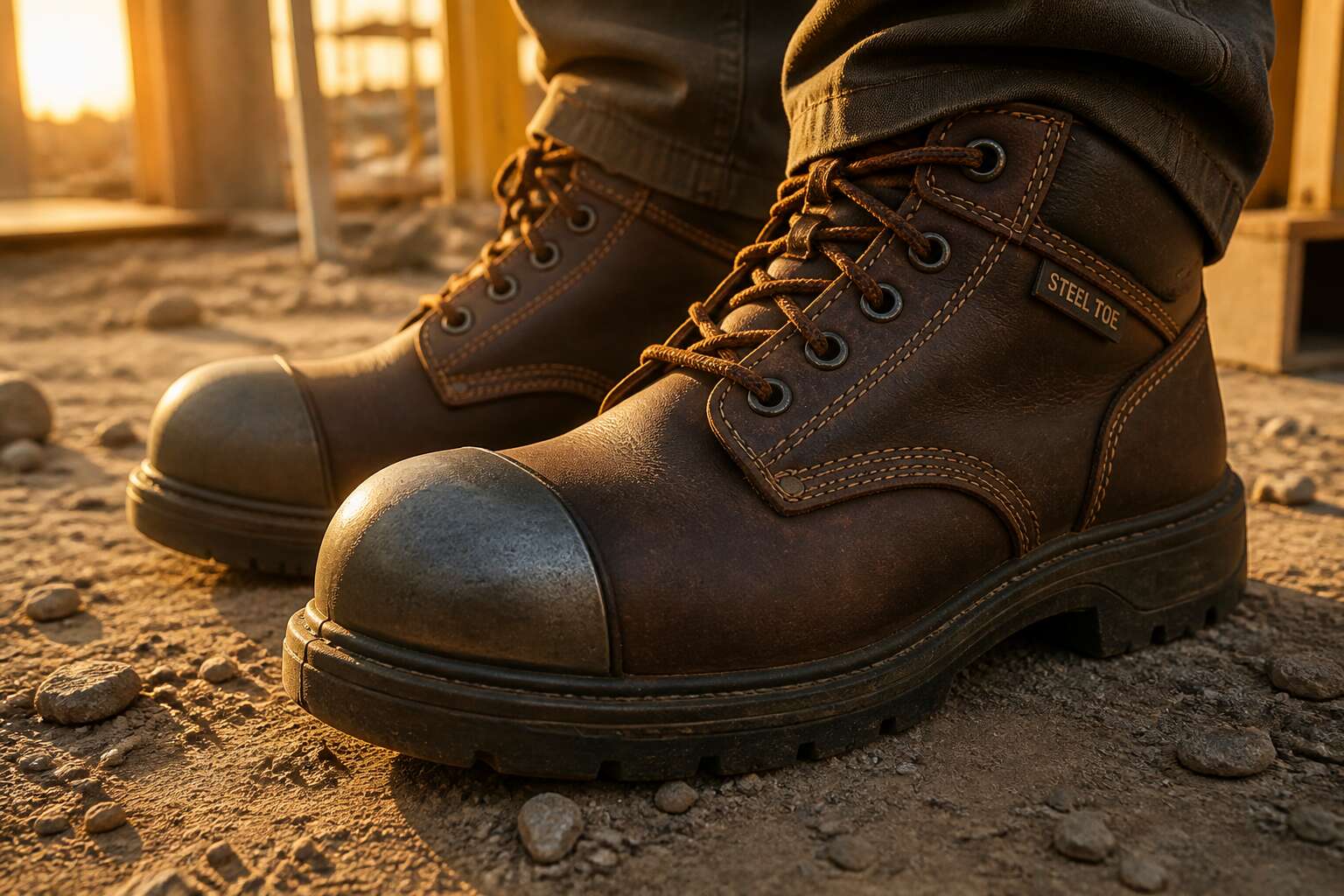
Understanding Steel Toe Protective Footwear
What Makes a Steel Toe Different
Nearly 40% of workplace accidents in South Africa involve lower limb injuries. Yet many workers still swap their safety boots with steel toe cap for lighter footwear on a hot shift. That choice can cost them a foot.
What makes a steel toe different from other protective options? The metal shell absorbs and disperses kinetic energy before it reaches your bones. Composite toe boots don’t conduct cold or heat, but they crack under extreme point loads. Steel simply bends and holds!
I have inspected boots after heavy impacts. The steel toe cap saved the wearer every time.
- Impact resistance exceeding 200 joules
- Compression resistance of at least 15 kilonewtons
- Full coverage across the phalanges
The safety boots with steel toe cap are engineered for these exact forces.
The Role of Impact and Compression Resistance
The most profound gap in workplace safety is the one between a certificate on a wall and a load that actually drops. Accreditation paperwork offers administrative comfort, yet the physical world operates on its own, unforgiving arithmetic. When a pallet shifts or a cylinder rolls, the only barrier between your metatarsals and the concrete is the engineered integrity of your current footwear. This is where the often cited specifications for safety boots with steel toe cap are forced to prove themselves under duress.
A key distinction to understand is that these boots do not prevent the initial impact. They prevent the catastrophic result of that impact. The steel shell is designed to deform in a controlled manner, absorbing the kinetic energy and channeling it around the structure of the foot. We are not discussing a rigid, immovable fortress, but rather a crumple zone that sacrifices itself to protect the phalanges. The true test of this design is not the singular, dramatic drop, but the sustained, crushing pressure that follows.
To meet South African safety standards, the protection must function across two distinct pressures:
1. Impact: The sudden application of force, measured in joules, from a falling object. This tests the bowl structure against a sharp, concussive blow.
2. Compression: The sustained, rolling force, measured in kilonewtons, from a heavy weight being placed or dragged upon the foot. This tests the vertical stability and resistance to being flattened.
I have always found it fascinating that many workers assume a boot is either safe or unsafe. They look for the heavy steel to reassure themselves, but they never consider the fatigue of the material. A steel toe that has already withstood a heavy impact may have sacrificed its structural rigidity to save you the first time. It has done its job, but it is no longer capable of doing it again with the same authority. The resilience is finite, and the generosity of the steel is a one-time offer.
This is not about feeling invincible, but about engaging with reality. The specifications exist to predict behaviour, not to provide a talisman. When you rely on safety boots with steel toe cap, you are betting on their ability to fail correctly, to bend and hold against a force that would otherwise shatter bone. It is a quiet, physical promise that happens away from the praise of management, in the split second between the slip and the impact.
Comparing Steel, Composite, and Alloy Toes
A steel toe is a point of pride, yet the material underneath the leather often escapes scrutiny. Steel remains the benchmark for safety boots with steel toe cap, but composite and alloy toes offer distinct advantages. Composite toes, crafted from non metallic fibers, ignore temperature extremes and pass through metal detectors without a beep. Alloy toes blend aluminum, titanium, and magnesium to reduce weight while preserving protective bulk. Consider these differences:
- Steel: maximum impact resistance, heavier, conducts cold
- Composite: lightweight, non conductive, bulkier profile
- Alloy: lighter than steel, slimmer than composite, still metallic
The choice depends on your environment, not your ego. A foundry worker and a warehouse supervisor live in different footwear worlds. Select based on daily realities, not marketing claims. The best boot disappears from your awareness until the moment it earns its keep.
How Steel Toe Caps Are Tested
Every pair of safety boots with steel toe cap faces a set of trials before reaching the market. South African standard SANS 1619 specifies how manufacturers test their protective metal. A 20 kilogram weight is dropped from one metre onto the toe area. The cap must deform without touching the wearer’s foot.
Compression testing applies a 10 kilonewton force. The cap must resist cracking while retaining its protective shape. Additional checks include corrosion resistance and the bonding strength between the cap and the boot’s sole. These tests are not formalities.
- Impact test with a 200 joule force.
- Compression test at 10 kilonewtons.
- Penetration test using a 4.5 mm steel pin.
Each number is a promise verified by machinery. When you hear that sharp clank on a site, it is the sound of a standard met. Safety boots with steel toe cap work until a falling object makes it necessary.
Industry Safety Standards and Regulations
ASTM F2413 Explained
According to the South African Bureau of Standards, over 3,000 disabling foot injuries occur in local workplaces each year, many of which could be prevented with proper protective equipment. When you choose safety boots with steel toe cap designs, you are engaging with a complex system of compliance that many workers never fully explore. The ASTM F2413 standard is the benchmark, but it is not a single test.
This standard acts as a family of requirements. It dictates how the steel toe cap must perform under specific weights and impact forces. More importantly, it outlines the exact marking system found on the tongue of your boots. You have likely seen codes like I/75 or C/75 stamped onto the leather. The “I” refers to impact resistance, while the “C” indicates compression resistance. The number, such as 75, represents the force measured in pounds. An “M” designation means the boot also protects the metatarsal area, a feature often overlooked but critical for heavy industry.
The standard itself does not insist on a specific material for the toe cap. It only cares about the result. This is why you should verify the protective elements of your footwear. For instance, the standard outlines the clearance height that must remain after a steel toe is subjected to a rigorous impact. This invisible safety margin is the difference between a functioning boot and one that offers false security. Many South African employers now demand ASTM certification as a baseline, making this knowledge essential for anyone reviewing safety boots with steel toe cap options on the market. The clarity of these regulations is what separates genuine protection from mere appearance.
EN ISO 20345: The European Standard
One standard cannot govern the world. While ASTM F2413 dominates the North American market, a different framework holds sway across the Atlantic, and it carries significant weight in South African import considerations. The EN ISO 20345 standard is the European benchmark for personal protective equipment, and it takes a broader, more granular approach to safety.
This standard does not simply look at impact and compression. It introduces a classification system that speaks to the entire boot, not just the toe. The baseline is the SB rating, which ensures basic impact resistance at 200 joules. However, the true value lies in the supplementary requirements that follow. A boot will often carry a rating like S1, S2, or S3, and understanding these codes is vital when sourcing safety boots with steel toe cap designs for different work environments.
– S1 ensures basic protection alongside antistatic properties and energy absorption in the heel.
– S2 improves upon S1 by adding water resistance to the upper material.
– S3 builds on S2 with a puncture-resistant sole, a requirement for outdoor construction.
The material specifications under this standard are precise. The steel toe cap must be located within strict dimensional tolerances, and the boot must withstand a 200 joule impact test against a 20 kilogram weight dropped from a specific height. The key difference here is the focus on the whole boot system, rather than just the protective toecap. This holistic view makes EN ISO 20345 a demanding and respected certification, one that provides a clear signal of quality for importers and safety officers alike. The choice between ASTM and EN ISO ultimately depends on your market, but the level of scrutiny involved in each ensures that safety boots with steel toe cap options remain a reliable line of defense.
The Importance of Certification Labels
A certification label on a boot is a quiet contract. It is a declaration that the equipment has survived a gauntlet of controlled violence, from falling weights to punishing compression tests. For the South African worker, this label is often the only visible proof that a product will hold up when the ground shifts or a load slips. Without this mark, a safety boot is merely a collection of leather and stitching, reliant on hope rather than evidence.
The label itself carries a hidden language. It tells you which standard the safety boots with steel toe cap have met, and more importantly, which they have not. A genuine mark offers an audit trail, a promise of traceability back to a certified factory. This is what separates dependable personal protective equipment from a counterfeit risk. The cost of that distinction can be measured in more than currency.
What a thorough certification label actually communicates:
– The exact impact energy absorbed during testing.
– The specific standard and year of its publication.
– The factory and batch identification for recall purposes.
When you inspect a label, you are verifying a product’s history. A certified pair of safety boots with steel toe cap options provides a documented answer to the question of whether the equipment will fail, or simply flex, under pressure. It is a reassurance forged in a laboratory.
Electrical Hazard vs. Insulated Boots
A single kilovolt can turn a routine shift into a hospital admission. Electrical hazard rated safety boots with steel toe cap are engineered to resist current flow when the wearer steps on a live conductor. Insulated boots perform an entirely different function, blocking thermal transfer from extreme cold or heat. They carry no electrical rating at all.
The distinction matters. I have seen skilled workers assume that a thick sole means protection from both frost and voltage. It does not. South African regulations separate these hazards into different test categories, and mixing them up can be catastrophic.
Electrical hazard testing measures:
– Current leakage under 18,000 volts.
– Resistance after water immersion.
– Six minute hold without breakdown.
Insulated boots answer to thermal standards instead. An employer choosing safety boots with steel toe cap options must first identify which hazard exists on site. The wrong pair offers a false sense of security.
Selecting Work Boots for Your Specific Job
Construction and Heavy Industry Needs
The Highveld wind carries dust and rust. On a construction site, the ground works against you. Selecting safety boots with steel toe cap protection for heavy industry is self preservation. The heel slips on wet rebar, the sole punctures on a stray nail, the steel toe absorbs the blow that would crush your foot. Your boots do the work no one sees.
A proper work boot accounts for the environment. Deep treads for mud-choked trenches, a puncture-resistant midsole for debris-strewn concrete slabs, and leather that resists abrasive quarry rock. The welds, stitching, and eyelets matter. So does the fit. A loose boot invites friction blisters that fester.
Consider the demands of your specific role:
- Do you climb steel beams or crawl through confined spaces?
- Does your shift involve standing on hard stone or wet clay?
- Does the heat demand breathable lining or waterproof membranes?
Each answer narrows the field. Safety boots with steel toe cap for a mine shaft differ from those worn on a scaffold. Listen to the site and choose accordingly.
Warehouse and Logistics Requirements
A distribution centre floor wears down feet every single shift. Concrete never softens, and forklifts never pause. For warehouse roles, safety boots need a slip-resistant outsole and cushioned midsole. A rugged lug pattern for mud is useless on polished concrete.
Think about your daily motions. Do you walk 15 kilometres across a stockroom or stand at a loading dock? Each task demands different support. Breathable lining matters when the afternoon sun heats a trailer to uncomfortable levels. These features warrant attention:
- Outsoles that grip dry and slightly oily floors.
- Shock-absorbing heels for repeated walking.
- A secure fit that prevents heel lift during quick turns.
Safety boots with steel toe cap built for flat, hard surfaces handle the demands. Your feet will thank you after the rush.
Electrical Work and Non-Conductive Options
Electricity respects no one, least of all a tired electrician’s feet. When selecting work boots for live circuits, the steel toe cap is your primary impact guard, but the non-conductive sole and heel are your true protection. These components, typically dense rubber or polyurethane, prevent current from travelling up your body.
Safety boots with steel toe cap designed for electrical work must have zero exposed metal. This includes metal eyelets and any metal shank. Verify the manufacturer’s electrical hazard rating, which confirms insulation capability.
Key verification points include:
– A rubber outsole free of cracks or wear
– A heel unit without embedded nails or conductive stitching
– A certification sticker covering the specific insulation test
In South Africa, load shedding drives casual generator use, and a stray extension lead is a common hazard. Choosing safety boots with steel toe cap that also insulate is your best move in this scenario.
Oil and Gas: Slip and Chemical Resistance
A petrochemical refinery floor is a landscape of unseen hazards. Oil films create a meniscus that can betray even the most careful step, while aggressive solvents wait to degrade inferior materials. For workers here, the single most vital component is not the protective toe, but the outsole compound. Safety boots with steel toe cap protection are essential, yet they are rendered useless without a tread capable of gripping a slick surface coated in drilling mud or hydraulic fluid.
Consider the environment on a rig or plant. Your boots encounter substances engineered to dissolve crude oil, and these same agents will attack certain rubber compounds. A standard sole might swell, soften, or lose its grip entirely. The right choice involves a specific blend of nitrile rubber, known for its resistance to hydrocarbons. The tread pattern also matters. A deeply lugged, self-cleaning design disperses liquids and debris, maintaining contact with the ground. For this sector, look for a heel with a defined, angled edge to prevent slip on steel gratings.
The push for local production and maintenance schedules adds another layer. When you operate near the refineries in Secunda or the coastal terminals in Durban, your equipment faces humid, corrosive air. A robust outsole is your primary defense, and the sole must remain pliable in fluctuating temperatures. Your questions should revolve around the outsole’s specific chemical resistance and its grip rating on oily surfaces. A boot that survives the toe impact but fails on a wet, oily walkway is a liability. The sole is the true interface between you and the treacherous ground, and it demands careful consideration.
Cold Weather Insulated Models
In the Highveld winter, temperatures can drop below freezing. The steel toe cap that protects you from impact also becomes a conduit for cold, drawing heat from your toes. For night shift workers or those in cold storage, insulation is a survival feature, not a luxury.
When choosing safety boots with steel toe cap for cold conditions, examine the thermal lining. Thinsulate and wool offer different levels of protection. Crucially, look for a thermal barrier between the steel cap and your foot. Without it, the metal shell sits directly against your sock and drains your body heat.
Here is what I check before recommending a cold weather model:
- The insulation rating matches the lowest temperature you will face
- The lining wicks moisture, because damp feet freeze faster than dry ones
- The outsole retains flexibility in sub-zero conditions
A rigid sole in winter is a hazard. It reduces your awareness of the ground beneath you. A good insulated boot balances warmth with mobility.
Prioritizing Comfort and Fit
Proper Sizing and Break-In Periods
Nearly 65% of on-site complaints involve sizing errors, not impact failure. A safety boots with steel toe cap fits differently because the cap steals space. Measure your feet in the late afternoon, when swelling peaks.
Keep a thumb’s width between your longest toe and the internal cap. The heel must hold firm with no slip, and the instep should feel wrapped, not pinched. Break-in periods span three to seven days. During this window, leather gradually conforms to your foot’s unique curves. Flex the boot at the ball of your foot daily to speed the process.
- Wear your regular work socks when trying sizes
- Test on a slope to check heel retention
- Kick a hard surface to confirm toe clearance
Forcing a tight fit leads to hotspots and early fatigue. Rotate two pairs if your budget allows, but never compromise on width. The right pair disappears from your awareness by the end of week two.
Insole and Arch Support Features
Your foot’s structure decides how long a pair of safety boots with steel toe cap stays comfortable. The insole absorbs shock, while arch support distributes pressure across the midfoot. Overlook these features, and every step exposes the rigidity of the toe box.
Look for insoles with contoured heel cups and removable cores. Good arch support lifts the metatarsal region, reducing strain on the plantar fascia. In South African conditions, moisture wicking materials keep feet dry. I test arch support by standing on one leg; if the boot wobbles, the support is too soft.
- Removable insoles allow custom orthotics
- Dual density foam handles impact and rebound
Pair the right insole with your safety boots with steel toe cap, and your gait stays natural through every shift. That quiet balance separates adequate boots from exceptional ones!
Breathability and Moisture Management
Comfort starts with the fit around the heel and the instep. A pair of safety boots with steel toe cap that pinches in the morning will only hurt worse by midday. Breathability matters as much as shape, especially under the African sun. The upper should let heat escape while repelling water from outside.
Moisture management depends on the lining. Polyester blends dry quickly, while treated leather moves sweat away from the skin. If your feet stay dry, the steel toe cap feels less intrusive. The tongue and collar need padding that doesn’t compress after a month. Ventilation holes near the toe box help, but only if they avoid letting dust inside.
Weight Considerations for All-Day Wear
Weight decides how a shift ends. A pair of safety boots with steel toe cap that feels agile in the shop can feel heavy by the third hour. The steel itself adds heft, so the sole and midsole must do the compensating. Look for a snug heel counter and a wide toe box to reduce slippage. Slippage forces your toes to grip, which tires the foot faster than any load.
Boots that balance weight properly share a few traits:
- a shock absorbing PU footbed that does not flatten midweek
- an outsole that tapers near the metatarsal area for natural flex
- a padded collar that holds the ankle without pressure points
When the weight sits close to the foot instead of swinging away from it, each stride stays efficient. That balance matters more than the raw number on the scale.
Extending the Lifespan of Your Safety Footwear
Cleaning and Conditioning Methods
Somewhere in a dusty workshop, a pristine pair of safety boots with steel toe cap sits unused, waiting for a day that never comes. Meanwhile, the boots being worn daily lose their integrity because nobody spends five minutes on maintenance. Research from the CSIR suggests regular cleaning adds months of service life. That is not trivial when you are standing on concrete for nine hours!
Cleaning should happen after each shift, not when the boot is caked in dried mud. Rinse off loose grime, then use a damp cloth and mild soap. Hot water and bleach damage leather and synthetic components.
The conditioning sequence requires patience.
- A thin layer of leather conditioner, applied while the boot is still slightly damp.
- A ten minute pause to let it absorb before buffing.
- Storage away from direct heat or sunlight.
When to Replace Worn Boots
There is a quiet moment when a boot stops being protective and becomes decorative. The steel toe cap may look intact, but the sole has softened. A safety boots with steel toe cap that fails under a dropped load is worse than no boot at all.
Inspect monthly. Look for cracks in the sole, exposed stitching, or a toe cap that moves under pressure. Repair a separated outsole only if the rest of the boot remains sound.
- Check the heel for uneven wear; this indicates gait problems that destroy the boot.
- Press the toe cap; if it flexes inward, the steel has fatigued.
- Examine the insole; once compressed to the shape of your foot, shock absorption is gone.
Replacement is necessary when the midsole shows creases that do not bounce back, or when water enters through the seams. A worn boot is a liability on a South African worksite.
Resoling and Repair Options
Resoling a pair of safety boots with steel toe cap costs a third of replacement, yet many workers skip it. I have seen perfectly good uppers thrown away because the outsole smoothed out. A cobbler can bond a fresh sole to your safety boots with steel toe cap if the toe cap shows no flex and the upper has no tears.
Repair options include heel buildup, lace replacement, and patching small cuts. The critical factor is the welt. A cracked or rotted welt makes further repair pointless.
- Test the steel toe cap with firm finger pressure before authorizing work.
- Request butyl or nitrile rubber soles for chemical resistance.
Catch damage early. A small repair today prevents a full replacement tomorrow.
Storage Tips to Prevent Damage
Where you store your safety boots with steel toe cap when the shift ends matters as much as how you treat them on the job. A hot car boot or a damp locker causes damage. Heat dries the leather, humidity breeds mould in the lining, and both attack the adhesives holding the sole to the upper.
I have seen boots fail not from impact but from neglect between shifts. Your safety boots with steel toe cap deserve better than being kicked into a corner.
Here is what works:
- Let boots dry naturally at room temperature, away from direct heat sources.
- Loosen laces and pull the tongue forward for airflow.
- Stuff newspaper inside overnight to draw moisture from the lining.
- Keep them off concrete floors; use a wooden shelf.
- Never seal wet boots in plastic bags.
Wet boots left sealed in a kit bag breed fungus. The steel toe cap resists corrosion, but the upper needs air. Consistent storage habits prevent early failure.
Budgeting for Durable Protection
Budget-Friendly Options That Still Comply
Cheap boots fail faster. That makes them expensive. But the priciest pair on the shelf is not always the smartest buy either. You need safety boots with steel toe cap that meet the exact standard for your site. Nothing more.
Start with the certification label. If it shows the right ASTM or EN ISO mark, the protection level matches a premium brand. What you sacrifice with a budget model is comfort, longevity, and moisture control. For occasional use, that trade-off makes sense. For daily grinding on concrete, spend more.
A practical approach to budgeting:
- Compare certified models from local suppliers. Imported boots carry import duties.
- Buy at the end of summer. Winter stock clears in South Africa’s warmer months.
- Check if your employer offers a PPE allowance. Many do.
A R500 pair that lasts one year beats a R300 pair that dies in three months. Do the maths before you pay. Your feet will feel the difference.
Premium Features Worth the Investment
When you budget for durable protection, the real question is what the boots cost per shift, not per rand. A pair of safety boots with steel toe cap that keeps its shape and grip for eighteen months is cheaper than one that fails in six, even if the shelf price is double. That is the first principle of value.
Premium features justify their price where they reduce strain. Full grain leather resists abrasion. A moisture wicking lining stops fungal growth. Dense polyurethane midsoles absorb impact on hard floors. The certification mark stays the same, but the daily experience does not.
- Full grain leather uppers with oil and water resistance
- Removable anti-bacterial insoles
- Direct injected soles that resist delamination
Spending more only makes sense where the work demands it. The certification label ensures compliance. The rest of the design determines whether safety boots with steel toe cap carry you through the week without complaint.
Warranty and Return Policies
A warranty is a promise written in terms of time. When you buy safety boots with steel toe cap, the length of that promise often tells you more than the marketing copy. A two year warranty against sole separation or toe cap exposure means the maker expects the boot to survive two years of actual work.
Return policies matter just as much. A boot that fits in the shop can feel different after eight hours on a concrete floor. South African workers often buy online, so the return terms decide whether a poor fit becomes a sunk cost.
The fine print on both documents is where the real budget lives. Exclusions for chemical exposure or improper storage are common, and those clauses define which failures the manufacturer accepts as their own.
Bulk Purchasing for Teams
The real price of a safety boot is measured in rands per working day, not the tag. For a single worker, a R1,200 boot lasting eighteen months beats a R700 boot lasting six. For a team of fifty, that arithmetic compounds and the margins shrink quickly.
Bulk purchasing changes the conversation entirely. You are buying predictable compliance, not footwear. A supplier who offers a fleet discount can standardize the safety boots with steel toe cap across shifts, simplifying fitting and spare stock. Savings only exist if you negotiate service terms like replacement turnaround.
The hidden costs stay hidden unless you write them down.
- Fitting sessions for every new hire.
- Storage for seasonal stock.
- Replacement units for immediate swaps.
Ignore these line items and the bulk discount evaporates. South African foremen often order on price alone. Durable protection that matters survives the warehouse floor and the payroll audit without a second purchase next quarter.

0 Comments