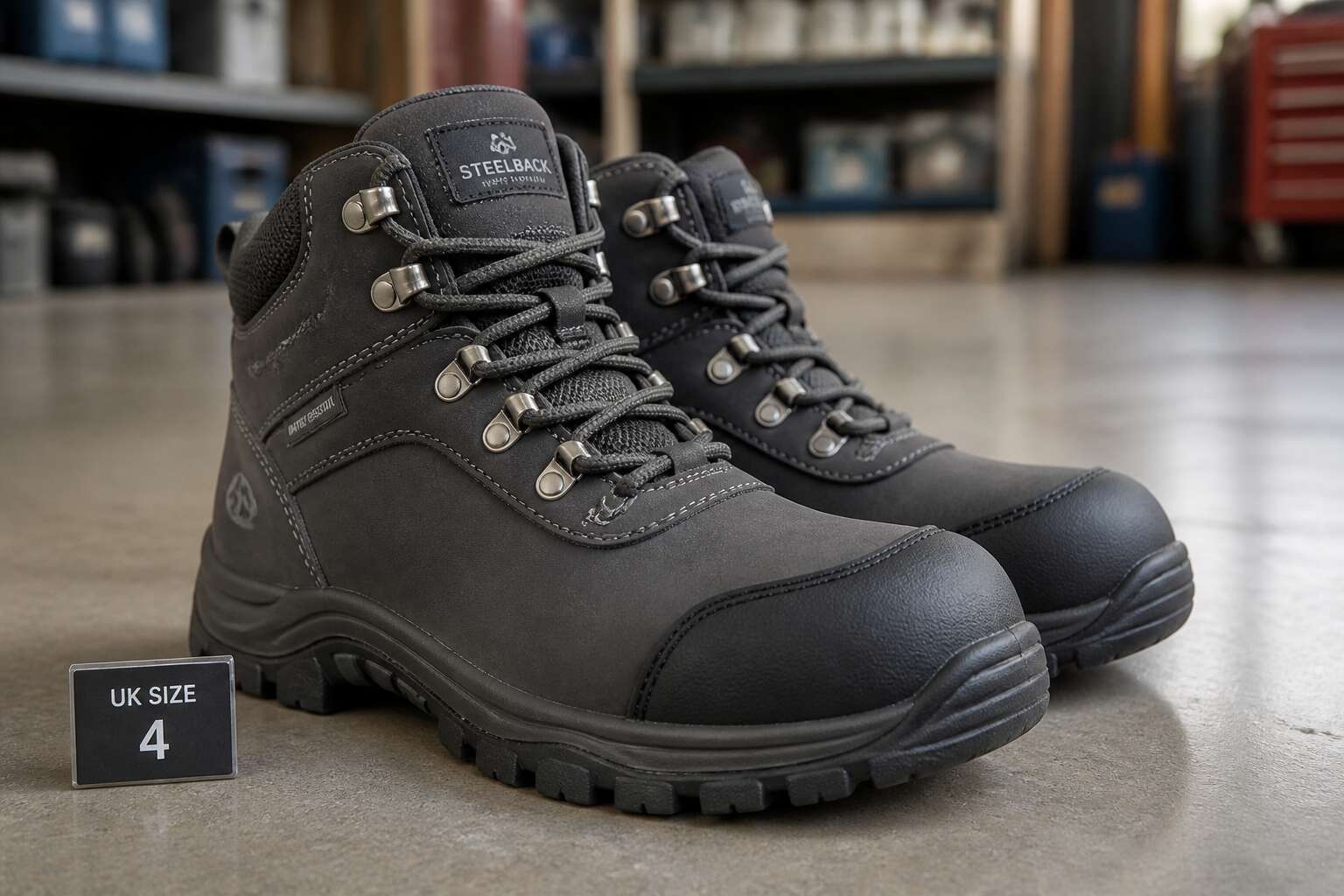
The Unique Fit Challenge for Smaller Feet
Why Standard Sizing Fails Petite Feet
Roughly 1 in 8 South African women wears a size 4 shoe, yet the safety footwear industry largely ignores them. Standard boots are built on a last shaped for a size 7 foot, then scaled down. The proportions stay wrong. A petite foot in a shrunken boot experiences heel slip, a high instep, and a toe box that lands too far forward.
- The heel cup remains too wide, so the foot lifts with every step.
- The instep area is too tall, creating pinching across the top of the foot.
- The toe box does not align with the actual toes, causing the foot to slide.
This is why womens safety boots size 4 cannot simply be a shorter version of a larger boot. The last itself must change. Womens safety boots size 4 need a narrower heel, a lower instep, and a repositioned toe box. Until manufacturers address these proportions, petite women will keep wearing boots that fit like hand-me-downs.
Understanding Foot Volume and Arch Dynamics in Compact Sizes
Consider the load. A size 4 foot supports the same body mass per stride as a larger foot, but over a smaller contact area. For womens safety boots size 4, the dorsal volume, the space above the midfoot, rarely scales down with length. Cramping across the metatarsal heads or a loose cradle that fails to hold the arch follows.
Arch dynamics complicate the picture. The plantar fascia runs a shorter course, tightening through a more acute angle with each step. A boot that ignores this forces the arch to flatten or overwork. The insole must mirror the compression pattern of a smaller foot. The heel bone sits closer to the ground, shifting the ankle joint into a different neutral position.
- Lower heel elevation changes calf muscle resting length.
- Midfoot volume sits proportionally higher in a compact foot.
No amount of lacing tension fixes boots built on the wrong volumetric assumptions!
The Hidden Dangers of Wearing Ill-Fitting Protective Footwear
In South Africa, worksites rarely pause to consider what a size 4 foot endures inside a boot built for a size 7. The hazard is real: protective footwear that fails to fit properly often creates a second set of dangers. A woman wearing womens safety boots size 4 must contend with slippage at the heel, which causes friction blisters, or a toe box that pinches the hallux, which leads to bruising and potential nail loss. Neither outcome improves safety.
The hidden dangers escalate when workers adapt. Wearing thicker socks to fill dead space changes the boot’s internal dimensions. Over-tightening laces to control heel lift restricts circulation and causes fatigue. These compensations become the norm, and fatigue is a known precursor to slips, trips, and falls. A steel toe cap that sits too far forward offers no protection, while one that sits too close crushes the toes under impact.
Workers in these boots face issues that are easy to miss during a short induction:
- Compromised proprioception from loose or heavy boots disrupts balance on uneven terrain.
- Impaired circulation from tight instep straps reduces foot temperature and sensation.
- Excessive boot weight forces the smaller foot to lift more mass with every stride.
For a woman working a 12 hour shift on a construction site in Johannesburg, these problems compound daily. Long term consequences include plantar fasciitis, bunions, and chronic ankle instability. Womens safety boots size 4 must offer a tailored fit without sacrificing the impact resistance required by SANS standards. A boot that cannot hold the heel securely or cradle the arch under heavy load is a risk factor, not a safety measure. The boot should fit like a glove, dense and supportive, or it fails the wearer on the very ground it is meant to protect.
How Toe Box Geometry Differs in Smaller Safety Shoe Constructions
The toe box of a womens safety boots size 4 is rarely a scaled version of larger sizes. When a manufacturer shrinks the last, the steel toe cap often retains a similar internal length, shifting the metatarsal hinge backward. The forefoot then meets a narrower arc, and the toes compress against a cap that did not anticipate such a small foot.
Smaller constructions change the geometry further. A steeper toe spring lifts the toes, which alters how the plantar pressure lands when standing:
- Space at the tip can disappear once the heel settles into the counter.
- The cap may press the little toe laterally during each stride.
A woman on a South African site needs a womens safety boots size 4 with a toe box that permits splay without letting the cap drift. The boot must hold the foot deep enough to keep toes clear of steel, yet low enough to avoid rubbing. Precision, not approximation.
The Impact of Boot Weight on Agility and Fatigue for Smaller Frames
The unique fit challenge for a womens safety boots size 4 extends beyond the toe box. The boot’s overall envelope must hug the instep without creating pressure points. A smaller foot slides forward when the lacing system does not tighten enough. That movement cancels the heel counter’s work, leaving the toes vulnerable to the steel cap.
Boot weight compounds the issue. A worker with a smaller frame carries less body mass, so a heavy boot represents a larger percentage of her total load. Each lift of the foot becomes a deliberate effort, and fatigue accumulates faster over a shift.
What matters for smaller frames:
- The sole should flex at the metatarsal hinge, not the arch
- The upper should stay firm at the ankle without bulk
- The outsole should grip without adding excess height
A womens safety boots size 4 that weighs less per step reduces fatigue and preserves agility. The boot must support the stride, not fight it.
Measuring Your Foot Correctly: Brannock vs. Actual Fit
Few things in life are as deceptively simple as a Brannock device. That silver contraption in shoe shops gives a measurement, but it is just a starting point. For womens safety boots size 4, that starting point often lies. Your foot spreads under weight, flattens with each step, and swells by early afternoon. The number you see is a starting estimate, not a final answer.
To find your true fit for womens safety boots size 4, measure your feet at the end of the workday. Stand up. Wear the socks you intend to wear on the job. Then do this:
- Trace both feet on paper while bearing weight.
- Mark the longest toe and the widest point.
- Compare the tracing to the boot’s internal length, not the outsole size.
The Brannock device offers a starting dimension. The tracing gives the truth. Inside a compact safety boot, even a few millimetres of error changes pressure across the instep. Measure twice. Your toes will thank you.
Key Features to Prioritize in Compact Safety Footwear
Composite vs. Steel vs. Aluminum Toe Caps for Low-Profile Design
Steel toe caps have a dirty secret: they add roughly 200 grams to the front of your foot, exactly where your toes bend. For womens safety boots size 4, that mass alters your stride. Composite toe caps solve the weight issue. They are lighter and don’t conduct heat or cold. Aluminum lands in between. It is lighter than steel but carries a lower impact rating. For petite frames, this choice changes boot behaviour. Composite allows manufacturers to build thinner soles. Steel demands extra room around the toe. Aluminum offers a slim silhouette but dents more easily. The tradeoff for compact sizing:
- Composite: lightweight and non conductive, bulkier in some brands
- Steel: maximum protection, heavy and clunky
- Aluminum: light and slim, lower impact rating
Womens safety boots size 4 should feel nimble, not cumbersome.
Outsole Traction Patterns Engineered for Reduced Surface Area
The engineering of outsoles often betrays the promise of a compact boot. For womens safety boots size 4, the ground contact patch is naturally smaller, which concentrates pressure. This demands a specific tread geometry, not just a scaled-down version of a men’s boot. Deep, aggressive lugs on a petite sole can create a rocking sensation, reducing stability on uneven factory floors in Johannesburg or Durban.
Traction is about channeling debris away, not just gripping. A self-cleaning tread pattern prevents mud and gravel from packing into the sole, which would otherwise turn the boot into a slippery platform. The careful spacing of lugs becomes a practical feature. For smaller feet, the perimeter of the outsole matters more than the center. You want the edges to bite into the surface.
When examining a pair, consider the composition of the rubber compound and the lug depth. A softer compound offers better grip on polished concrete but wears faster. A harder compound lasts longer but compromises on slick surfaces. The design should also include:
– A defined heel landing zone for smoother weight transfer
– Angled lugs that release water to reduce hydroplaning
– A flared lateral edge to widen the base without adding bulk
The result is a boot that feels planted. The goal is to mimic the security of a larger boot. A turbine-cut tread pattern, often found on higher-end models, allows the smaller outsole to flex more naturally with the foot. This reduces fatigue, as the shoe works with the natural gait cycle. I recommend checking for a reverse-direction pattern at the toe to assist with climbing, as this is a detail often overlooked in smaller sizes.
Insulation, Waterproofing, and Breathability Without Bulk
Condensation forms inside a compact boot faster than in a larger one, and that moisture directly affects stability. For womens safety boots size 4, the insulation and waterproofing layers must be thin enough to preserve the small internal volume, yet effective enough to handle a wet shift on a Johannesburg site.
Microporous membranes such as ePTFE block liquid water while permitting vapour to escape. A synthetic insulator like Thinsulate offers warmth at half the thickness of fleece. The upper should carry a hydrophobic finish, not a thick waterproof coating that cracks within weeks. A brushed polyester lining dries quickly, outperforming a dense pile that holds sweat against the skin.
Adjustable Retention Systems for Narrow Heels and Low Insteps
The Achilles tendon is the most unforgiving architect of a poor fit. In womens safety boots size 4, a heel that slips by two millimetres can create a friction blister within the first hour of a shift. The fix lies in the retention system, not the width marker. Look for a lacing structure that extends past the traditional eyestay, allowing independent tension over the instep. A micro-adjustable strap across the midfoot, similar to a ski boot mechanism, locks the heel back into the boot’s counter. This feature is critical for a low instep, where the foot lacks the natural bulk to fill the boot’s throat.
Do not rely on a tongue that is simply padded. The tongue must be gusseted and anchored, preventing lateral movement when you walk on uneven ground. A low instep often causes the laces to cinch the upper too tightly, creating a pressure point on the dorsal nerve. An adjustable system with a memory foam collar at the Achilles, rather than rigid leather, will hold the heel without strangling it. Consider these priority features:
- Asymmetrical lacing loops that mimic the foot’s natural curve
- A lace-lock hook positioned at the highest pressure point
- Metal D-rings that release tension during prolonged squatting
These systems distribute force evenly, which is essential when the boot’s footprint is smaller because every square centimetre of contact bears more pound-force. For narrow heels, a split-kit system, which combines a hidden elastic panel with a rigid heel counter, offers the best of both worlds. It provides stability during lateral cuts while allowing the calcaneus to move naturally during the gait cycle. The womens safety boots size 4 that succeeds uses these components as a single, cohesive unit.
Electrical Hazard and Slip Resistance Ratings Explained
Compact does not mean compromised. For womens safety boots size 4, the ratings printed on the tongue matter more than the leather grain. Electrical Hazard (EH) certification requires the sole and heel unit to withstand 18,000 volts. The boot protects you only while dry and intact. A cracked sole voids that guarantee instantly!
Slip resistance works differently in a compact footprint. The reduced contact patch of womens safety boots size 4 means the tread must work harder. Under SANS 20345, the SRC rating requires passing ceramic tile and steel plate tests with glycerine. Wet soapy surfaces expose weak grip quickly.
I always check for a dual density sole. The softer top layer absorbs impact; the harder bottom layer resists penetration.
The label should show:
- ASTM F2413 EH rating
- SRC slip rating for wet and oily surfaces
- Non-marking outsole compound
These elements separate a boot from a hazard.
Workplace Applications and Safety Standards
Navigating ASTM F2413 and EN ISO 20345 Certifications
In South African mines and workshops, the certification printed inside the tongue of a boot carries legal weight. For womens safety boots size 4, that weight often shifts. ASTM F2413 measures impact and compression protection. EN ISO 20345 adds slip resistance, energy absorption, and heel protection criteria. These standards are not interchangeable.
Consider the environments where these boots work: wet plant floors, sharp steel edges, uneven rock faces. A size 4 boot that passes ASTM F2413 may fail EN ISO 20345 requirements for energy absorption at the heel.
- Check for the C(EH) marking for electrical hazard protection
- Verify the outsole’s slip rating matches your floor conditions
- Look for puncture resistant midsoles in scrap metal environments
When a compact boot carries both certifications, it signals real engineering for smaller frames.
Lightweight Manufacturing and Logistics Roles Requiring Precision Fit
In lightweight manufacturing, the floor is the hazard. Conveyor lines, pallet jacks, and steel racking leave no room for a boot that shifts inside itself. Womens safety boots size 4 with a snug heel pocket keep the foot planted during repetitive bending and reaching. The outsole must shed dust and grip polished concrete.
Logistics roles add another variable. Workers climb in and out of forklifts and step over dock edges. A compact boot with a lower profile reduces trip risk. The toe cap should not add bulk that catches on pallets.
Common requirements in these roles:
- Snug fit through the midfoot to prevent friction
- Low-profile toe cap that fits under racking
- Outsoles that resist oil on smooth warehouse floors
Womens safety boots size 4 need a precise fit for these tasks. Loose heels cause fatigue. Wide toe boxes catch on machinery.
Outdoor, Agricultural, and Equestrian Uses for Petite Safety Footwear
Outdoor work in South Africa tests a boot against thorns, mud, and sun-baked earth. I have watched petite workers struggle with boots that shift at the heel. Womens safety boots size 4 need a precise heel lock for uneven ground.
Agricultural and equestrian tasks add unpredictable animal movement and slippery stable floors. The toe must resist impact without catching on stirrups or fencing.
- Outdoor: ankle support on rocky terrain
- Agricultural: puncture resistance in orchards and vineyards
- Equestrian: low-profile toe for stirrup clearance
Safety standards for these uses focus on penetration resistance and slip performance on organic matter, not just factory floors. That distinction matters!
Healthcare and Hospitality Demands: Anti-Fatigue Meets Protection
Healthcare corridors and hospitality kitchens demand a different calculation from a construction site. A nurse on a twelve-hour shift covers roughly seven kilometres, and a hotel housekeeper lifts and twists through dozens of rooms. For womens safety boots size 4, anti-fatigue midsoles and fluid-resistant uppers matter as much as toe protection. I have seen petite workers in Cape Town clinics tolerate a loose heel for an hour, then limp by lunchtime.
Safety standards for these sectors emphasise sustained comfort under load. Look for:
- Slip-resistant outsoles tested on wet tile and oil
- Puncture-resistant plates that stay flexible
- Heel counters that lock the foot without pressure
Overcoming the ‘One-Size-Fits-All’ Gender Design Gap
Every workplace has its own culture of safety, yet the tools we issue often tell a different story. For decades, womens safety boots size 4 were simply scaled down from men’s lasts, ignoring the narrower heel and higher instep that define the female foot. That gap is closing, though slowly.
Consider the mine sites in Mpumalanga or the engineering plants in Gauteng. Safety officers now demand more than a stamped certification for womens safety boots size 4. They want boots that actually perform on a smaller frame.
The ASTM F2413 standard does not differentiate by gender, which means a size 4 boot must absorb the same impact as a size 12. That is a rigorous expectation.
Workplace requirements increasingly include:
- Flexible puncture-resistant plates that bend with a lighter step
- Outsoles with denser tread zones to compensate for reduced surface area
- Lacing systems that lock the midfoot without crushing the instep
These are not luxuries. They are safety parameters.
Regulatory Compliance When Sourcing Small Safety Footwear in Bulk
Sourcing womens safety boots size 4 in bulk for a Johannesburg logistics hub or a Durban chemical plant demands more than a competitive quote. Procurement teams must verify that each pair meets the same ASTM F2413 impact and compression thresholds as larger sizes. The supplier should provide batch test certificates, not just a single sample report.
Workplace applications for small safety footwear range from warehouse picking to field maintenance. Compliance officers in South Africa also look for SABS marking and traceability. A useful checklist for bulk orders includes:
- Verification of heat stamping on each boot
- Documentation of slip resistance testing per batch
- Confirmation that puncture resistant plates cover the full footbed
Without these checks, a bulk order can quietly fail the very workers it was meant to protect.
Top Brands and Models Supplying This Niche Size
Established European Heritage Brands with Narrow-Size Availability
European heritage manufacturers take small sizing seriously. Haix, the German house, produces select safety boot models down to UK size 2, which equals a womens safety boots size 4. Their narrow lasts support slender heels without loosening ankle grip. Elten offers similar options from EU 35 upward, popular in warehouse roles where precise fit prevents blisters.
French brands also contribute. Aigle makes protective wellingtons in compact sizing, though importers in South Africa carry limited stock. Dedicated European supply chains ensure these small sizes are built on true narrow lasts.
- Direct-inject soles that reduce boot height while retaining puncture resistance
- Replaceable insoles for customising instep volume
- Heel counters engineered for narrow feet
A womens safety boots size 4 from these brands carries the same certifications as larger sizes, with geometry adjusted properly.
Emerging Direct-to-Consumer Labels Challenging Traditional Fit
The market for womens safety boots size 4 is no longer the exclusive domain of century old factories. A wave of direct to consumer labels is emerging, built on the premise that petite feet deserve modern engineering, not hand me down lasts. These brands use digital fit tools and modular insoles to create a personalised experience that traditional retailers struggle to match.
I have seen the difference in the warehouse, where a woman used to strap on an ill fitting men’s boot just to get the job done. These new labels treat fit as a data problem, not a guess. They often provide:
– 3D foot scanning apps that map volume and arch height
– Replaceable heel grip inserts for a locked in feel
– Interchangeable footbeds that alter instep pressure
This approach is shifting expectations. A direct to consumer brand can offer a womens safety boots size 4 with a composite toe cap that is 15% lighter than the old steel options, yet still meets the EN ISO 20345 standard. They source outsoles from suppliers who understand reduced surface area, meaning slip resistance is tuned for a smaller footprint. For a South African woman who has spent years doubling up on socks, the arrival of these labels is a quiet revolution, a recognition that safety and comfort are not mutually exclusive.
Comparing Unisex Styles vs. Dedicated Womens Lasts
Most unisex classifications are a polite fiction. A men’s size 6 last scaled down does not account for a woman’s narrower heel or lower instep. Dedicated women’s lasts, by contrast, adjust the heel curve and toe spring entirely.
A handful of established brands have quietly produced dedicated womens safety boots size 4 models for decades. Their approach differs from unisex styles in one critical way: the boot’s volume distribution. A unisex boot often leaves excess material across the vamp, while a women’s last pulls that fabric tighter around the midfoot.
For a woman shopping for womens safety boots size 4, the difference shows in the heel pocket. Trust me, it is obvious the moment you lace up. Consider models like:
- Oliver Footwear’s AT range, built on a true women’s last
- Blundstone’s safety series with a narrower heel cup
- Terra’s low-volume composite toe options
These deliver a locked heel without compressing the toes. That distinction matters on a concrete floor in Johannesburg.
Custom and Semi-Custom Manufacturing Options for Specialty Needs
Most workers assume womens safety boots size 4 means settling for whatever stockists keep on the shelf. That assumption costs them. Oliver Footwear’s AT range and Blundstone’s safety series are the obvious starting points, but HAIX and Lowa also produce compact women’s lasts that reach South African distributors.
The custom route runs quieter. Semi-custom manufacturing, where a manufacturer adjusts heel cup depth or instep volume on an existing last, is available through select suppliers! Options include:
– Reduced vamp volume for low insteps
– Custom insole contouring for arch support
– Shortened shaft heights for petite calves
These adjustments turn a functional boot into a precise one. Procurement teams face longer lead times, but the drop in foot fatigue and injury claims justifies the wait.
Where to Shop: Verified Retailers and Fitting Strategies
The shelf offers one pair of womens safety boots size 4 and a shrug. HAIX and Lowa compact lasts reach selected South African distributors, while Oliver Footwear’s AT range and Blundstone safety series appear at specialist PPE outlets in Johannesburg and Cape Town.
- HAIX XR3 compact women’s last
- Lowa Renegade Work GTX in small sizes
- Oliver AT 45 series
Fitting strategies at verified retailers involve checking heel cup depth and instep volume with a Brannock device and a thin sock, then walking on a hard surface. Stores that stock spare footbeds allow a half-size swap to resolve pressure points without a special order.
Maintenance and Durability Strategies
Extending the Life of Toe Caps and Protective Layers
Some workers assume a toe cap can never fail. It can. Corrosion, impact fatigue, and chemical exposure gradually weaken the protective shell. For anyone wearing womens safety boots size 4, the compact construction leaves less material around the toe, so damage spreads faster. Inspect the cap after each major job. Run a fingertip along its edges to find dents, cracks, or rust where moisture collects.
Condition the leather upper after every cleaning, because micro-cracks let water reach the internal composite layer. Replace worn laces and eyelets early. I have seen a loose fit cause the foot to slide forward, jolting the toes into the cap with every stride. Rotate two pairs so the boot dries fully between shifts. That alone keeps the protective layers intact for far longer.
Cleaning and Conditioning Leather for Harsh Industrial Environments
Industrial grit abrades leather fibers on womens safety boots size 4 at an accelerated rate. The smaller surface area concentrates abrasion near flex points. I have watched a single shift in a foundry leave a compact boot’s upper stiff and dull. Conditioning after cleaning restores oils that harsh detergents strip away.
Salt, acids, and alkaline dusts degrade stitching before the leather shows wear. A neutral pH cleaner followed by a thin layer of conditioner keeps the grain supple. Heavy waxes trap grit in seams. The tighter curves around the heel and instep on a compact last demand a light hand with product.
Replacing Insoles for Sustained Cushioning in Petite Sizes
The insole inside womens safety boots size 4 endures a peculiar punishment. A compact foot presses the same force through a smaller area, so the foam collapses faster than it would in a larger boot. You might notice a dull ache in the arches long before the sole shows visible damage.
Replacing the insole every four to six months restores that original cushioning. A low-profile option works best, because a thick replacement crowds the toe box and changes how the boot fits around the heel. The original footbed in most petite boots is already thin; swapping it for something bulkier defeats the design.
A simple rotation habit keeps womens safety boots size 4 feeling fresh:
- Own two pairs and alternate them daily
- Let the compressed foam recover overnight
- Replace both insoles at the same time
This approach extends the life of the boot itself, since the footbed, not the outsole, usually fails first in smaller sizes.
Recognizing Wear Signs Specific to Smaller Footwear
Smaller footwear fails quietly. In womens safety boots size 4, the stress points sit closer together. The upper creases hard just behind the toe cap. That fold turns into a crack before the outsole looks worn. Tap the leather there. You can feel the weakening.
Check the heel seam for puffing. A petite foot rotates more inside the boot, pulling at that stitch line. Also run a thumb over the tread. The lugs on size 4 are tiny. They flatten faster than you expect. When the center lugs feel smooth, traction gets iffy.
Keep two pairs in rotation. The compressed midsole needs time to expand. Dry them away from heaters. Heat ruins the adhesives. These actions stretch the boot’s working life.
Seasonal Storage and Shape Retention Techniques
Taking care of womens safety boots size 4 demands a different rhythm. The smaller surface area means sweat and grime concentrate faster. I wipe mine down with a damp cloth after every shift, then apply a thin layer of balm. That routine keeps the leather supple and stops the crease zone from hardening prematurely.
Seasonal storage is where most petite boots lose their shape. Stuff the toe compartment with acid-free tissue, not newspaper. The ink transfers onto the lining. Keep them upright in a cool closet, away from the daily temperature swings of a South African garage.
- Rotate between two pairs during humid months.
- Use cedar shoe trees to hold the heel collar shape.
- Store left and right boots separately to avoid pressure marks.
When to Rely on Professional Resoling vs. Replacement
A cobbler’s assessment matters once the upper outlasts the sole. On womens safety boots size 4, replacement often follows compressed toe caps or cracked leather at the flex point, not simple tread loss. Professional resoling suits uppers with sound stitching and intact protective layers. I have seen a sturdy pair return from a Johannesburg repairer with its profile restored. Replacement is appropriate when the safety toe feels loose in its housing or the heel counter has collapsed.
The decision rests on structure and damage.
- Resole when the midsole holds shape and the upper has no deep cuts.
- Replace when the toe cap shifts, the lining tears at the ball, or moisture lingers after drying.

0 Comments